
Habit Stacking 101: How to Build Habits on Habits You Have

Starting a new habit from scratch is hard. You have to remember it, find time for it and talk yourself into it, every single day. Habit stacking is a simple way around that: instead of building a new habit on its own, you attach it to something you already do.
Here's what habit stacking is, why it works, what the research behind it actually says, and how to build your first stack.
The short answer
- Habit stacking means linking a new habit to an existing one: "After I [current habit], I will [new habit]."
- It's a form of if-then planning. A review of 94 independent tests with more than 8,000 people found that if-then plans had a medium-to-large effect on reaching goals (Gollwitzer & Sheeran, 2006).
- Habits form when a behavior is repeated after the same cue. A cue that's already part of your daily routine gives you "a convenient and stable starting point" (Gardner et al., 2012).
What is habit stacking?
Habit stacking is the practice of pairing a new behavior with a habit you already do automatically. The existing habit becomes the reminder. A few examples:
- After I make my bed, I will write one line in my journal.
- After I pour my morning coffee, I will stretch for two minutes.
- After I brush my teeth at night, I will read one page.
The current habit is often called the anchor. Some behavior designers describe it as the moment that "prompts" the new habit: you don't need an alarm or a sticky note, because the anchor already happens every day.
Once one link feels easy, you can add another after it. Bed made, then journal, then read. That chain is the "stack."
Why habit stacking works

Habits are triggered by cues. Researchers describe habits as actions that are triggered automatically by the situations we're in, after we've repeated them in that situation many times (Gardner et al., 2012). Habit stacking gives a new behavior a clear, reliable cue from day one.
A lot of daily life already runs on habit. In diary studies, between a third and a half of the behaviors people listed were habits, done almost every day and usually in the same place (Wood et al., 2002). That means you already have plenty of anchors to build on.
It takes the deciding out of it. Psychologists call plans in the form "If situation Y happens, then I will do X" implementation intentions. Making the plan ahead of time links the situation to the action, so when the moment arrives you're more likely to act without having to decide again (Gollwitzer, 1999). "After I make my bed, I will journal" is exactly that kind of plan.
What the research says
If-then plans help people follow through. Gollwitzer and Sheeran pooled 94 independent tests with 8,461 participants. Forming an if-then plan had a medium-to-large effect on goal attainment (d = .65) compared with only intending to reach the goal (Gollwitzer & Sheeran, 2006).
Repeating a behavior after a daily cue builds habit over time. In a well-known study, 96 people picked a new eating, drinking or exercise behavior and did it after a cue in their day, such as having fruit with lunch or doing sit-ups after morning coffee. On average it took 66 days for the behavior to get close to its peak automaticity, with a range of 18 to 254 days. Missing a single day didn't have much effect on the process (Lally et al., 2010; BPS summary).
Simpler actions get easier faster. In the same study, exercise habits took longer to become automatic than eating or drinking habits. Gardner and colleagues also note that simple actions become habitual faster, which is why it's smart to start your stack small.
So the honest summary is: there's strong evidence for if-then plans and for repeating a behavior after a stable cue. Habit stacking puts those two ideas together. It isn't a magic shortcut, and the "stack" itself hasn't been tested as its own named method, but it's built on well-studied pieces.
How to build your first habit stack
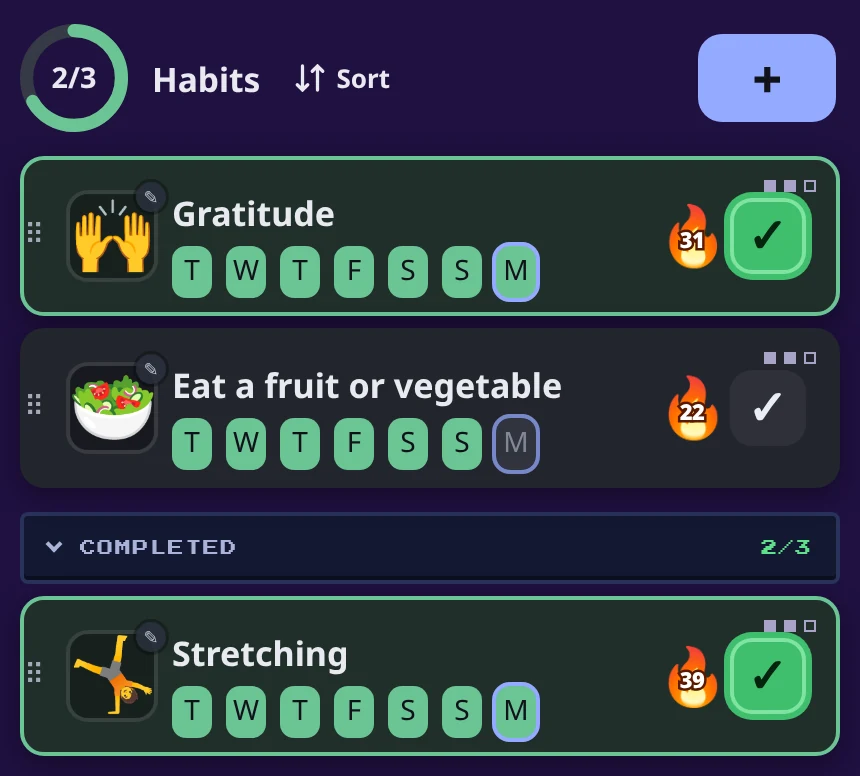
- List your anchors. Write down things you already do every day without thinking: waking up, making coffee, brushing your teeth, sitting down for lunch, getting home.
- Pick one small new habit. Make it tiny at first: one page, two minutes of stretching, one line in a journal.
- Match the habit to the anchor. The anchor should happen at a good time and place for the new habit. Stretching fits after coffee better than after you're already in bed.
- Write it as a sentence. "After I [anchor], I will [new habit]." Writing the plan makes it specific.
- Do it right after the anchor. The closer the new habit follows the cue, the stronger the link.
- Track it. Checking it off each day shows you whether the link is holding. Gardner and colleagues suggest a simple tick sheet may help with this.
- Add the next link later. Once the first stack feels easy, attach another small habit to the end of it.
Habit stacking examples
- Morning: After I make my bed, I will journal one line. After I journal, I will read for a few minutes.
- Mid-day: After I sit down for lunch, I will eat a piece of fruit first.
- Evening: After I take off my shoes at home, I will stretch for two minutes. After I stretch, I will write down one thing I'm grateful for.
- Night: After I plug in my phone, I will plan tomorrow.
Common habit stacking mistakes
- Choosing a weak anchor. If the anchor doesn't happen every day, the new habit won't either. Pick something you truly do daily.
- Stacking too much at once. A five-habit chain on day one is easy to drop. Start with one link.
- Making the new habit too big. "Run 5 km after breakfast" is a lot to ask. Start tiny and grow it.
- Giving up after a miss. A single missed day had little effect in the research. Missing one day won't break your habit, so just pick it back up at the next anchor.
How LevelHabit helps you stack habits
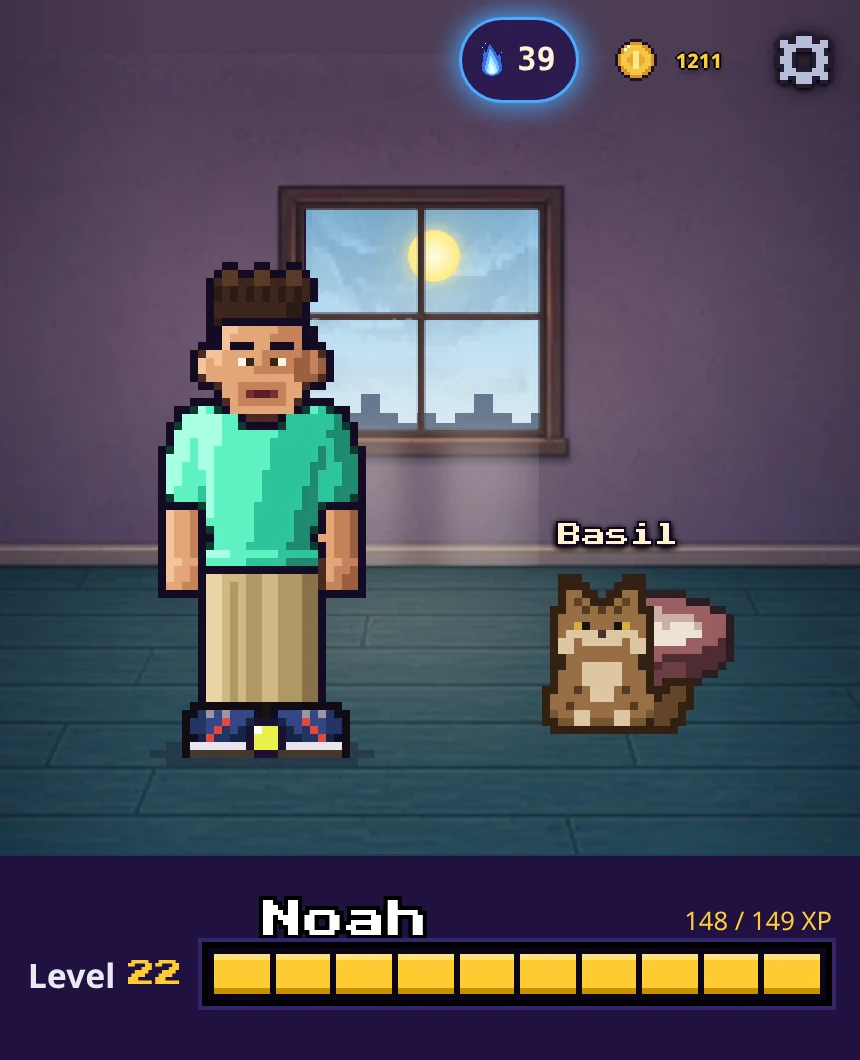
LevelHabit is a pixel-art RPG habit tracker. You can keep your stack short and visible: add your two or three linked habits, and check each one off as you go. Every check earns XP right away, fills your hero's level bar, and your streaks and weekly day pills show whether each link in your stack is holding.
You create your own hero, pick a pet, and start with just a few habits. A daily quest gives you a small, specific goal for the day.
If you have ADHD, pairing a new habit with a routine you already have, plus quick visible feedback, may help you remember it. In one study, children with ADHD who made if-then plans did better on a self-control task (Gawrilow & Gollwitzer, 2008). It isn't a treatment, though. If you think you might have ADHD, talk to a doctor or a qualified professional. You can also read about choosing a habit tracker for ADHD.
Key takeaways
- Habit stacking links a new habit to one you already do: "After I [current habit], I will [new habit]."
- It combines two well-studied ideas: if-then plans and repeating a behavior after a stable cue.
- If-then plans had a medium-to-large effect on reaching goals across 94 tests.
- Habits took 66 days on average to become automatic in one study, with a wide range, and one missed day didn't matter much.
- Start with one strong anchor and one tiny habit, track it, then add the next link.
FAQ
What is habit stacking?
It's a way to build a new habit by doing it right after something you already do every day, like journaling after you make your bed. The existing habit works as the reminder.
Does habit stacking work?
It's built on research that does: if-then plans and cue-based repetition both have good evidence behind them. Results depend on the person, the anchor and how small the new habit is.
How many habits should I stack?
Start with one new habit linked to one anchor. Once it feels easy, add another link. Two or three habits in a stack is plenty for most people.
How long does it take for a habit stack to stick?
It varies a lot. In one study, new daily habits took 66 days on average to become automatic, ranging from 18 to 254 days. See how long it takes to form a habit for more.
Build your first stack today
Build your hero, pick your pet, and check off each link in your habit stack.
Sign up free · Ages 13+
Sources
- Gollwitzer, P. M., & Sheeran, P. (2006). Implementation intentions and goal achievement: A meta-analysis of effects and processes. Advances in Experimental Social Psychology, 38, 69–119. https://doi.org/10.1016/S0065-2601(06)38002-1
- Gollwitzer, P. M. (1999). Implementation intentions: Strong effects of simple plans. American Psychologist, 54(7), 493–503. https://doi.org/10.1037/0003-066X.54.7.493
- Lally, P., van Jaarsveld, C. H. M., Potts, H. W. W., & Wardle, J. (2010). How are habits formed: Modelling habit formation in the real world. European Journal of Social Psychology, 40(6), 998–1009. https://doi.org/10.1002/ejsp.674
- Gardner, B., Lally, P., & Wardle, J. (2012). Making health habitual: The psychology of 'habit-formation' and general practice. British Journal of General Practice, 62(605), 664–666. https://pmc.ncbi.nlm.nih.gov/articles/PMC3505409/
- Wood, W., Quinn, J. M., & Kashy, D. A. (2002). Habits in everyday life: Thought, emotion, and action. Journal of Personality and Social Psychology, 83(6), 1281–1297. https://doi.org/10.1037/0022-3514.83.6.1281
- Gawrilow, C., & Gollwitzer, P. M. (2008). Implementation intentions facilitate response inhibition in children with ADHD. Cognitive Therapy and Research, 32(2), 261–280. https://doi.org/10.1007/s10608-007-9150-1
Related: How long does it take to form a habit? · The science of self-monitoring · ADHD and rewards · ADHD cleaning routine: a room-by-room plan · The habit loop: cue, routine, reward · Start tiny: the two-minute habit idea