
Why Missing One Day Won't Break Your Habit

You've done your habit every day for two weeks. Then one day just doesn't happen: you're sick, you're traveling, or you simply forget. The streak counter drops to zero, and a little voice says, "Well, that's ruined."
It isn't. Missing one day won't break your habit. In the best-known study of how habits form in real life, missing a single day didn't materially affect the process. What matters much more is what you do the day after. Here's what the research says, why one slip can feel so big, and how to bounce back without the guilt.
The short answer
- In a 12-week study of people building a new daily habit, missing one opportunity didn't materially affect habit formation (Lally et al., 2010).
- Habits build up through repetition in a consistent situation, so the overall pattern counts more than any single day (Gardner et al., 2012).
- Being kind to yourself after a setback was linked to more effort to improve, not less (Breines & Chen, 2012).
What the research says about a missed day
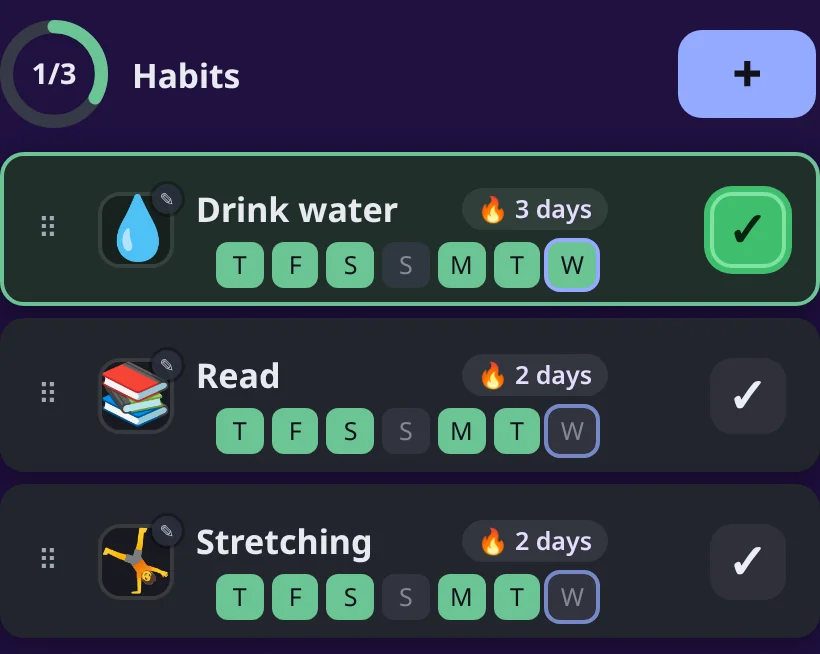
In the study, 96 volunteers each picked one eating, drinking or activity habit, like having a piece of fruit with lunch, and did it daily in the same situation for 12 weeks. Every day they rated how automatic it felt (Lally et al., 2010).
Automaticity grew along a curve: big gains early on, then smaller ones until it leveled off. And when people missed a day, the curve didn't snap back to the start. The researchers found that missing one opportunity to do the behavior did not materially affect how the habit formed.
That doesn't mean misses never matter. The same study found that the time it took varied a lot from person to person. A habit is built by repeating it over and over in the same context, so lots of misses mean fewer repetitions. One day off is a blip. A month off is a different story.
Why one slip feels like a fail
If one miss barely matters, why does it feel so bad? A big part of it is all-or-nothing thinking: "I did it every day" turns into "I failed," as if 13 good days don't count anymore.
Streak counters can make this worse. A number that jumps from 14 to 0 looks like you lost everything, even though your brain kept every one of those 14 repetitions. The danger isn't the missed day itself. It's the urge to say "forget it" and quit for good.
Be kind to yourself: it helps you get back on track
It's tempting to think being hard on yourself is what keeps you going. Research suggests the opposite.
In four experiments, people who were encouraged to treat a mistake with self-compassion were more motivated to improve afterward than people in comparison groups. In one experiment, after failing a hard test, students in the self-compassion group spent longer studying for a second test than students who got no intervention (Breines & Chen, 2012).
So after a missed day, try talking to yourself like you'd talk to a friend: "Yesterday got away from me. That's normal. I'll do it today."
Use "fresh starts" to your advantage

People tend to start (or restart) goals at natural turning points. One set of studies found that Google searches for "diet," gym visits and goal commitments all went up after "temporal landmarks" like a new week, a new month, a holiday or a birthday. At one university gym, the chance of a visit was 33% higher at the start of a new week than at baseline (Dai et al., 2014).
The researchers suggest these moments help people feel separated from past slip-ups. You don't need to wait for Monday, though. Tomorrow morning is a fresh start too. Treat "the day after a miss" as its own little landmark.
How to bounce back after a missed day
- Don't miss twice if you can help it. One miss is a blip. Make the next day the one that counts.
- Shrink the habit for a day. Can't do 20 minutes of stretching? Do two. A tiny rep still keeps the routine alive.
- Tie it to the same cue. "After lunch" or "after I brush my teeth" works better than "sometime today" (Gardner et al., 2012).
- Look at the whole week, not the streak. Six out of seven days is a great week.
- Plan for the days you know are hard. Travel, late shifts and sick days happen. Decide ahead of time what the small version looks like.
- Skip the guilt. Note what got in the way, adjust if you need to, and move on.
How LevelHabit handles a missed day
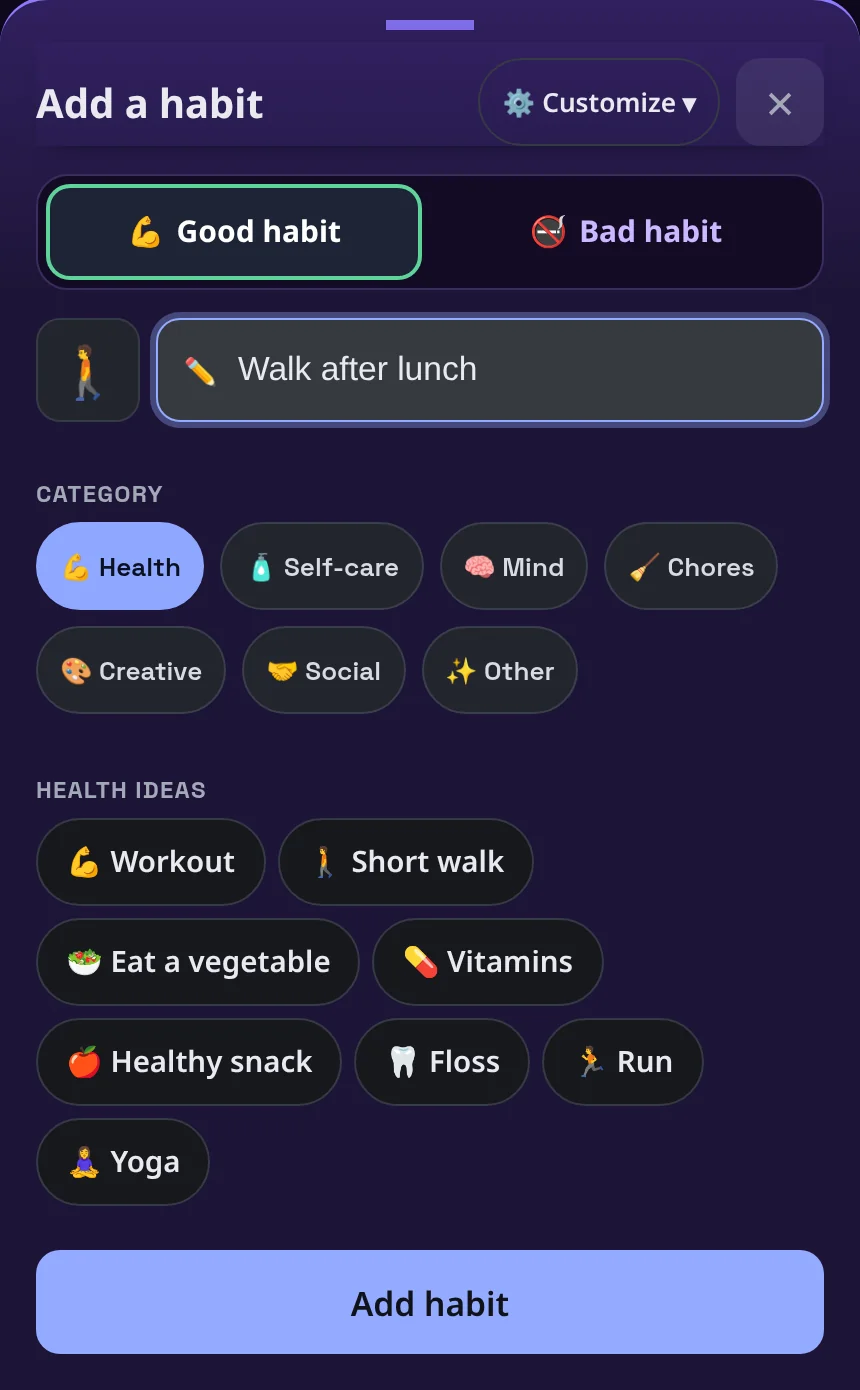
LevelHabit is designed so a missed day stings a little, not a lot. Your hero's level and XP stay put when you miss a day. Only the streak counter starts over, and your 7-day history still shows all the days you did show up.
Every habit you check off earns XP for your hero, and your pet is right there in the room with you. The next time you open the app after a miss, there's nothing to "make up." You just tap the check and keep going.
If you have ADHD and forgetting is part of daily life, a setup like this may help take some of the sting out of missed days. It isn't a treatment, though. If you think you might have ADHD, talk to a doctor or a qualified professional.
FAQ
Does missing one day reset a habit?
No. In research, missing one opportunity didn't materially affect habit formation. Your streak counter might reset, but the repetitions you've already done still count.
How many days can I miss before a habit breaks?
There's no proven number. Habits form through lots of repetition in the same situation, so the more often you miss, the slower it builds. The safest plan is to get back to it the very next day.
Should I restart my habit from day one after a miss?
No need. You're not starting over. Pick up where you left off, and if it helps, make the habit smaller for a few days.
Are streaks bad for building habits?
Not necessarily. Streaks can be motivating. Just remember the streak is a counter, not the habit itself, and losing it doesn't erase your progress.
Missed a day? Start again today.
Build your hero, pick your pet, and turn every comeback into XP.
Sign up free · Ages 13+
Sources
- Lally, P., van Jaarsveld, C. H. M., Potts, H. W. W., & Wardle, J. (2010). How are habits formed: Modelling habit formation in the real world. European Journal of Social Psychology, 40(6), 998–1009. https://doi.org/10.1002/ejsp.674
- Gardner, B., Lally, P., & Wardle, J. (2012). Making health habitual: The psychology of ‘habit-formation’ and general practice. British Journal of General Practice, 62(605), 664–666. https://pmc.ncbi.nlm.nih.gov/articles/PMC3505409/
- Breines, J. G., & Chen, S. (2012). Self-compassion increases self-improvement motivation. Personality and Social Psychology Bulletin, 38(9), 1133–1143. https://doi.org/10.1177/0146167212445599
- Dai, H., Milkman, K. L., & Riis, J. (2014). The fresh start effect: Temporal landmarks motivate aspirational behavior. Management Science, 60(10), 2563–2582. https://doi.org/10.1287/mnsc.2014.1901
Related: How long does it take to form a habit? · Do habit trackers actually work?