
Do Habit Trackers Actually Work? What the Research Says

You've probably tried one: a habit app, a printable chart, a row of boxes in a notebook. For the first week it feels great. Then you start to wonder whether all that checking off is actually doing anything.
So, do habit trackers work? The short answer from the research: tracking your progress does help people follow through, but a tracker on its own won't turn a behavior into a habit. Here's what the studies say, why tracking helps, where it falls short, and how to get the most out of one.
The short answer
- Tracking (researchers call it self-monitoring) is one of the best-supported tools in behavior change research.
- A large meta-analysis found that monitoring your progress helped people reach their goals, especially when progress was actually recorded.
- Tracking mostly helps you repeat a behavior. Making it automatic also takes a consistent cue and time.
What the research says
Monitoring progress helps people reach goals
The biggest study on this question is a 2016 meta-analysis of 138 experiments with nearly 20,000 people. In each one, some people were prompted to monitor their progress toward a goal and others weren't. Monitoring helped people reach their goals, and the more often people actually checked their progress, the more it helped. The effect was bigger when progress was physically recorded or shared with others (Harkin et al., 2016).
Self-monitoring keeps showing up
A 2009 analysis of 122 healthy eating and exercise programs (over 44,000 people) found that self-monitoring explained more of the differences between programs than any other technique. Programs that paired self-monitoring with at least one related technique, like setting goals or getting feedback, worked noticeably better (Michie et al., 2009).
A 2011 review of 22 weight-loss studies found the same pattern: tracking food, exercise or weight was consistently linked with more weight loss. The authors also pointed out that the evidence was weak in places because of how the studies were designed, so it's a strong pattern, not a guarantee (Burke et al., 2011).
Habits take time, and one missed day is okay
In a study where 96 volunteers repeated a new daily behavior in the same context for 12 weeks, it took an average of 66 days for the behavior to feel automatic, with a range of 18 to 254 days. Missing one opportunity didn't materially affect habit formation (Lally et al., 2010). There was some evidence that lots of misses added up over time, though (BPS summary).
Why habit tracking works

Researchers describe monitoring as the step between setting a goal and reaching it (Harkin et al., 2016). In everyday terms, a tracker likely helps because it:
- Shows the gap. You can see where you are and where you want to be, so you can adjust.
- Keeps the goal in front of you. Opening the tracker is a small daily reminder that the habit matters.
- Gives feedback now. A check mark today feels better than a result that's months away.
- Makes progress visible. A row of check-ins is proof you're becoming someone who does this.
Where habit trackers fall short
Tracking isn't magic. Here are the honest limits:
- Tracking supports repetition more than automaticity. In a 4-week study, reminders helped people repeat a behavior but got in the way of it becoming a habit, while event-based cues (doing it right after something you already do) led to more automaticity. Positive reinforcement on its own didn't help in that study (Stawarz et al., 2015).
- Many apps stop at tracking. The same team reviewed 115 habit apps and found most focused on self-tracking and reminders rather than cues.
- Streak pressure can backfire. If one miss feels like failure, it's tempting to quit. Since one missed day doesn't materially hurt habit formation, a good tracker makes it easy to pick back up.
- Tracking too much burns you out. Logging 12 new habits on day one is a fast way to stop logging any of them.
- The research has limits too. Many of these studies rely on people reporting their own behavior, which isn't perfect.
How to make a habit tracker work for you
- Start with 2 or 3 habits. Small wins beat a 12-habit Monday.
- Tie each habit to a cue. "After I pour my coffee, I drink a glass of water." Event-based cues helped habits become automatic in the study above.
- Log it right away. Make the check-in part of the habit, not something you catch up on later.
- Keep logging fast. If tracking takes more than a few seconds, it becomes its own chore.
- Plan for misses. If you skip a day, just do the next one.
- Look back once a week. Which habits stuck? Which cue isn't working? Adjust one thing.
- Pick a tracker you enjoy opening. You'll only benefit from the one you actually use.
Want a deeper checklist? We wrote about what makes the best habit tracker app.
How LevelHabit puts this into practice

LevelHabit is a pixel-art habit tracker built around these ideas (see how it works):
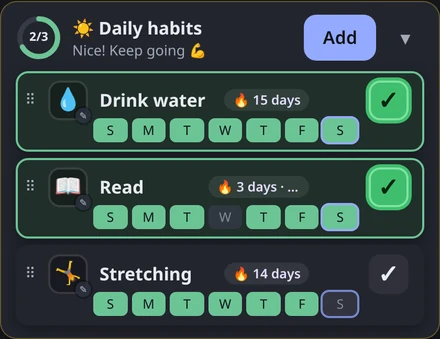
- One-tap check-ins with a 7-day history on every habit, so your progress is recorded and easy to see.
- XP and levels on every check-in, for feedback right now.
- Daily quests like "two habits back to back" that nudge you to stack habits together.
- Kind streaks: every habit shows its streak, and streak flames are just for show, so a missed day never takes away your XP, levels or badges.
- A hero and a pet who give you a reason to open the app that isn't just "I should."
You can also read about the research behind LevelHabit.
FAQ
Do habit trackers actually work?
For most people, yes. Across 138 experiments, monitoring progress helped people reach their goals. Trackers work best when you pair them with a consistent cue and give the habit time.
Do habit tracker apps work better than paper?
The research doesn't pick a winner. What mattered was actually recording your progress. Choose the format you'll use every day.
Do habit trackers work for ADHD?
They may help. Quick feedback and visible progress may make routines easier to stick with for some people with ADHD, but a habit tracker isn't a treatment. Our guide to habit trackers for ADHD covers which features to look for. If you think you might have ADHD, talk to a doctor or a qualified professional.
How long does it take for a habit to stick?
In one well-known study, it took an average of 66 days, with a range of 18 to 254 days depending on the person and the habit.
What if I break my streak?
Missing one day didn't materially affect habit formation in research. Just pick it back up the next day.
Ready to start tracking?
Build your hero, pick your pet, and turn your habits into XP.
Sign up free · Ages 13+
Sources
- Harkin, B., Webb, T. L., Chang, B. P. I., Prestwich, A., Conner, M., Kellar, I., Benn, Y., & Sheeran, P. (2016). Does monitoring goal progress promote goal attainment? A meta-analysis of the experimental evidence. Psychological Bulletin, 142(2), 198–229. https://pubmed.ncbi.nlm.nih.gov/26479070/
- Michie, S., Abraham, C., Whittington, C., McAteer, J., & Gupta, S. (2009). Effective techniques in healthy eating and physical activity interventions: A meta-regression. Health Psychology, 28(6), 690–701. https://pubmed.ncbi.nlm.nih.gov/19916637/
- Burke, L. E., Wang, J., & Sevick, M. A. (2011). Self-monitoring in weight loss: A systematic review of the literature. Journal of the American Dietetic Association, 111(1), 92–102. https://pubmed.ncbi.nlm.nih.gov/21185970/
- Lally, P., van Jaarsveld, C. H. M., Potts, H. W. W., & Wardle, J. (2010). How are habits formed: Modelling habit formation in the real world. European Journal of Social Psychology, 40(6), 998–1009. https://onlinelibrary.wiley.com/doi/10.1002/ejsp.674
- British Psychological Society Research Digest (2010). How to form a habit. https://www.bps.org.uk/research-digest/how-form-habit
- Stawarz, K., Cox, A. L., & Blandford, A. (2015). Beyond self-tracking and reminders: Designing smartphone apps that support habit formation. Proceedings of the 33rd Annual ACM Conference on Human Factors in Computing Systems (CHI '15), 2653–2662. https://doi.org/10.1145/2702123.2702230
Related: What makes the best habit tracker app · Habit tracker for ADHD: a practical guide