
Best Habit Tracker App: What Makes One Great
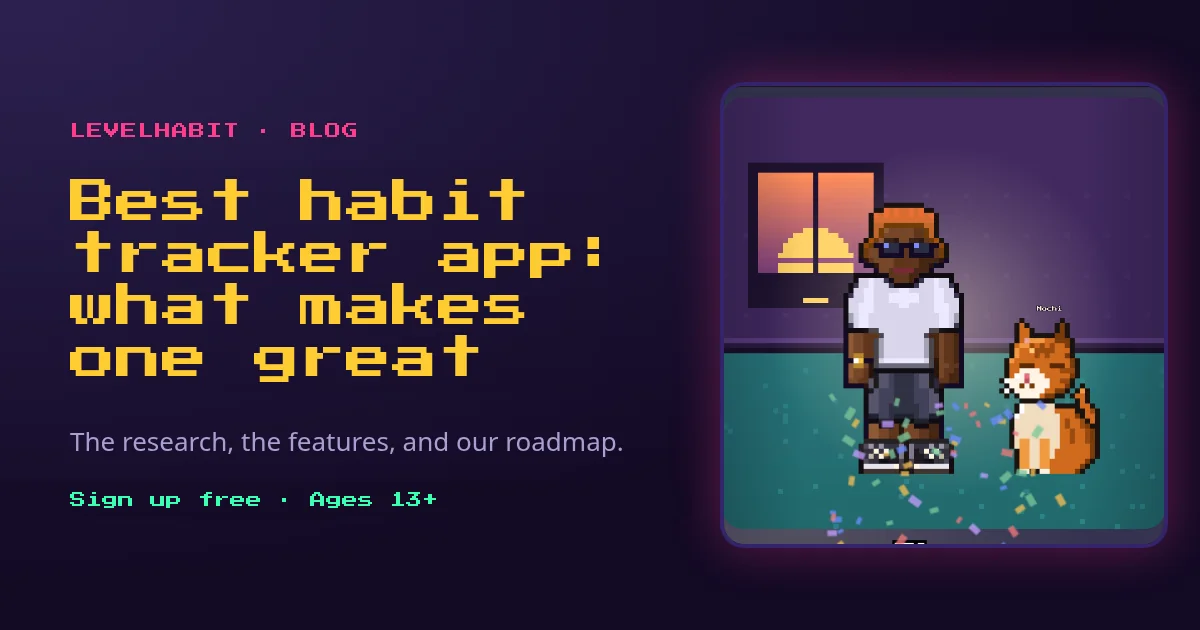
Search "best habit tracker app" and you'll find plenty of ranked lists. This isn't one of those. It's a goal, written down in public: we're aiming to make LevelHabit the best habit tracker app out there.
We're not there yet, and we won't pretend to be. But a goal is easier to hit when you can see it, so here's what we think makes a habit tracker great, what the research says, and how LevelHabit is building toward it, one update at a time.
What makes a habit tracker app "the best"?
Most "best of" lists compare prices, platforms, and widgets. Those matter. But the best habit tracker is the one you're still opening on day 60. That comes down to four things.
1. It makes tracking easy (because tracking works)
Writing down your progress isn't busywork. A meta-analysis of 138 studies found that monitoring progress toward a goal helped people reach it, and the effect was bigger when progress was physically recorded (Harkin et al., 2016). A great tracker makes that one tap, not a chore.
2. It's built for the long haul
New habits take longer than "21 days." In one well-known study, it took an average of 66 days for a daily behavior to feel automatic, and anywhere from 18 to 254 days depending on the person (Lally et al., 2010; BPS summary). The best app keeps things fresh for months, not just the first week.
3. Its streaks are kind
The same study found that missing one day didn't meaningfully hurt habit formation (Lally et al., 2010). So an app that makes you feel like you failed after one off day is working against you. Streaks should be a bonus, not a threat.
4. It gives you feedback right now
Many habits pay off slowly, so a small reward in the moment helps you show up. A review of gamification research found that most studies reported positive effects on health and wellbeing, especially for everyday health behaviors, though the evidence is still early and mixed in places (Johnson et al., 2016). That's why we lean on points, levels, and visible progress, and why we keep testing what actually helps.
How LevelHabit is building toward it
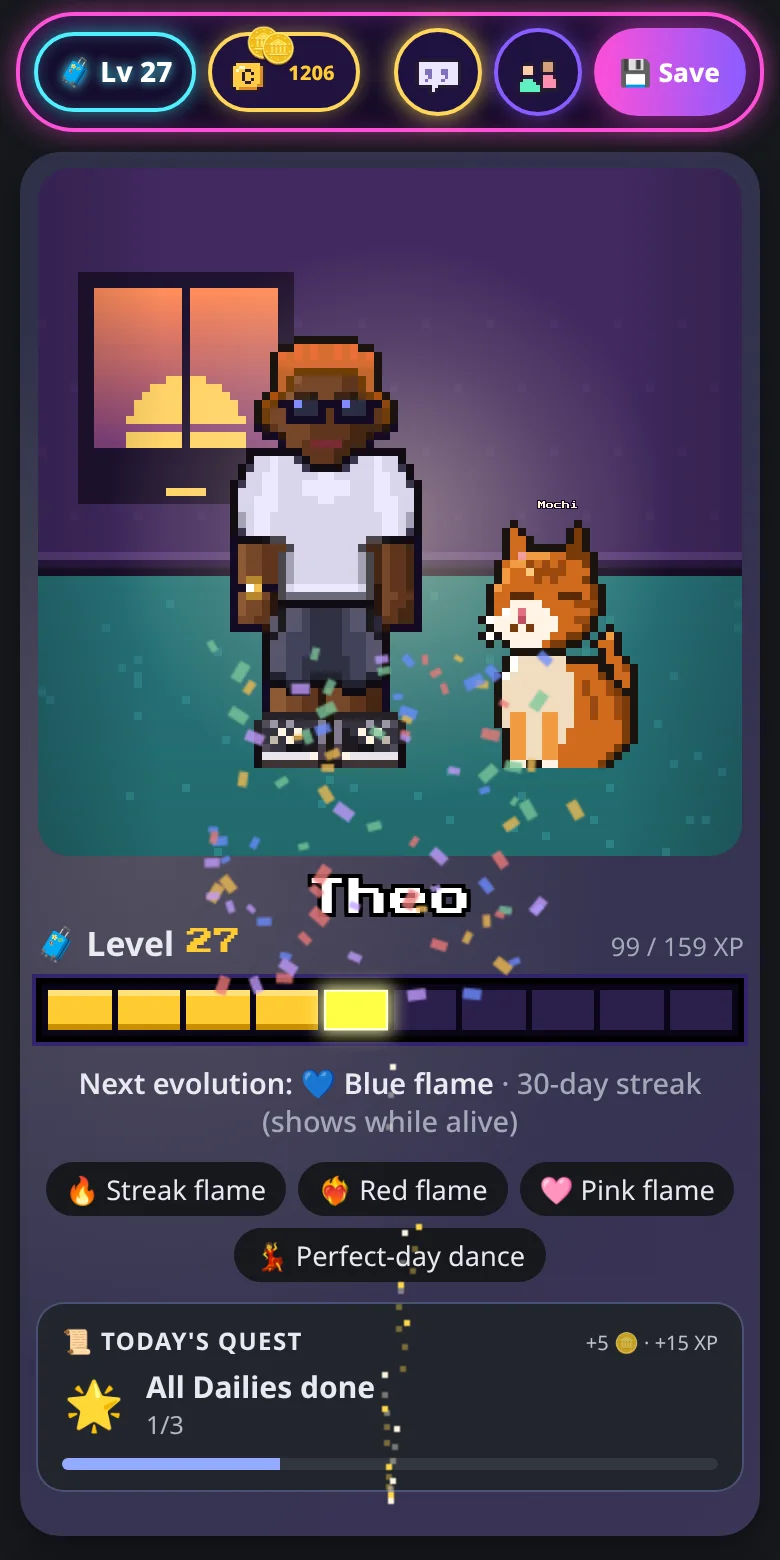 Theo just checked off two habits: confetti falls, his XP bar fills, and his orange tabby Mochi keeps him company. Next up: a blue flame at a 30-day streak.
LevelHabit is a pixel-art, gamified habit tracker where your real-life habits power a hero. Here's what's in the app today, mapped to the list above (see how it works).
Instant feedback on every check-in
- XP and levels: every habit you complete earns XP and levels up your hero.
- Combos: check off habits back to back for combo bonuses.
- Perfect Day: finish your whole list for an extra celebration.
Streaks that never punish you
Your streak flame changes color as it grows, from your first flame to red, pink and blue. Flames are just for show, so if you miss a day, your XP, levels and badges stay right where they are.
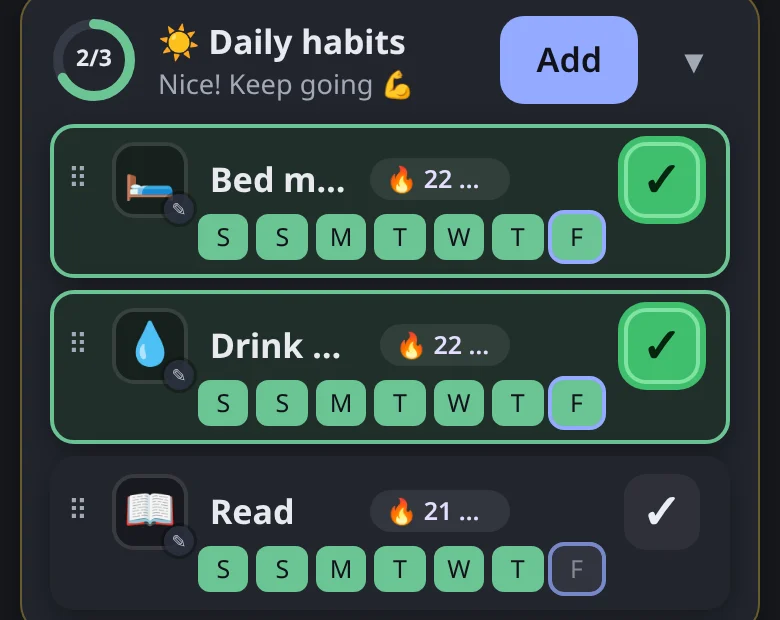 Two of three daily habits done. Every row shows its streak and the last seven days at a glance, and you can drag rows to reorder them.
Progress you can see (and care about)
- Hero evolution: your hero grows and changes as you stay consistent (meet your hero).
- A cozy room: keep up with habits like making your bed and doing the dishes, and your hero's room goes from messy to tidy to cozy.
- Pets: pick a companion from 16 dogs and 16 cats, and give them a name.
- 21 rank hats: earn a new hat every few levels, from Seedling at level 1 to Mythic. Prefer your hairstyle? Hide the hat. You keep the rank either way.
- Badges to collect along the way (see rewards).
Easy to use, every day
Habit rows are slim, so more of your day fits on one screen, and the phone nav bar keeps your habits, your hero and your Bag one tap away.
Built with ADHD brains in mind
Instant rewards and visible progress may help if plain checklists tend to get forgotten. It's a tool, not a treatment. We wrote more about this in our guide to gamified habit trackers for ADHD, and you can read why I built LevelHabit in the first place.
Our roadmap
Being the best habit tracker app is a moving target, so here's how we plan to keep earning it:
- Keep it kind. No guilt trips, no scary streak resets. Missing a day should never cost you your progress.
- Keep it fresh. More adventures and more ways to customize your hero are on the way, so month three feels as fun as week one.
- Keep it simple. Every new feature has to make checking off a habit easier, not harder.
- Keep listening. LevelHabit is built by a solo developer, and player feedback shapes what comes next.
We'll share progress on the blog and in our patch notes as we go.
How to choose a habit tracker (whichever one you pick)
- Try it for a few weeks. Habits take time, so give the app time too.
- Start with 2 or 3 habits. Small wins beat a 12-habit Monday.
- Check how it handles a missed day. If one skip makes you want to quit, it's not the right fit.
- Look for instant feedback. You should feel something the moment you tap "done."
- Pick one you enjoy opening. Fun is a feature.
FAQ
What is the best habit tracker app?
The best one is the one you'll keep using. Look for easy tracking, kind streaks, instant feedback and progress you can see. We're aiming for LevelHabit to be the best habit tracker app, and this post is our plan for getting there.
Is LevelHabit the best habit tracker app?
Not yet, and we won't claim it. It's our goal, and we're building toward it with every update.
What makes a good habit tracker?
Research suggests tracking your progress helps you reach goals, habits can take around 66 days to feel automatic, and one missed day doesn't ruin a habit. A good tracker makes logging easy, keeps you motivated for months, and doesn't punish you for an off day.
Does a gamified habit tracker work?
It may help. A review of gamification studies found mostly positive effects on health behaviors, though the evidence is still early. Points, levels and visible progress give you a small reward right away.
Can a habit tracker help with ADHD?
It may help with daily routines, but it isn't a treatment. If you think you might have ADHD, talk to a doctor or a qualified professional.
Who is LevelHabit for?
Anyone 13 and up who wants their habits to feel more like a game.
How do I get LevelHabit?
Sign up free at levelhabit.com.
Come build it with us
Build your hero, pick your pet, and help shape the habit tracker we're aiming to make the best one out there.
Sign up free · Ages 13+
Sources
- Harkin, B., Webb, T. L., Chang, B. P. I., Prestwich, A., Conner, M., Kellar, I., Benn, Y., & Sheeran, P. (2016). Does monitoring goal progress promote goal attainment? A meta-analysis of the experimental evidence. Psychological Bulletin, 142(2), 198–229. https://pubmed.ncbi.nlm.nih.gov/26479070/
- Lally, P., van Jaarsveld, C. H. M., Potts, H. W. W., & Wardle, J. (2010). How are habits formed: Modelling habit formation in the real world. European Journal of Social Psychology, 40(6), 998–1009. https://onlinelibrary.wiley.com/doi/10.1002/ejsp.674
- British Psychological Society Research Digest (2010). How to form a habit. https://www.bps.org.uk/research-digest/how-form-habit
- Johnson, D., Deterding, S., Kuhn, K. A., Staneva, A., Stoyanov, S., & Hides, L. (2016). Gamification for health and wellbeing: A systematic review of the literature. Internet Interventions, 6, 89–106. https://pubmed.ncbi.nlm.nih.gov/30135818/
Related: Habit tracker for ADHD: a practical guide · Building habits with ADHD: my story