
How Long Does It Take to Form a Habit? (Not 21 Days)

You've probably heard it: stick with something for 21 days and it becomes a habit. It's a nice, tidy number. It's also not what the research found.
So, how long does it take to form a habit? The short answer: in the best-known study, about 66 days on average, but anywhere from 18 to 254 days depending on the person and the habit. Here's where the 21-day idea came from, what the studies actually say, why some habits take longer, and how to get through the long middle.
The short answer
- In a study that followed people building a new daily habit, it took a median of 66 days for the habit to feel automatic, with a range of 18 to 254 days (Lally et al., 2010).
- A 2024 review of 20 studies found typical times of 59 to 66 days (medians) and 106 to 154 days (averages), with individual times from 4 to 335 days (Singh et al., 2024).
- So plan for about two months or more, not three weeks, and expect your number to be different from someone else's.
Where the 21-day myth comes from
Researchers at University College London went looking for the source of "21 days" and traced it to a self-help book from 1960. Its author, a plastic surgeon, wrote that patients took about 21 days to get used to their new face (UCL, 2012).
That's about getting used to a change, not about a behavior becoming automatic. Somewhere along the way the two ideas got mixed up, and "21 days" stuck. As the UCL researchers put it, it's "unfounded as a basis for habit formation."
What the research says
The 66-day study
In the study most people mean when they say "66 days," 96 volunteers picked one eating, drinking or activity habit and did it every day in the same situation, like "after breakfast," for 12 weeks. Every day they rated how automatic it felt (Lally et al., 2010).
The pattern looked like a curve: the first repetitions gave the biggest jump, then the gains got smaller until they leveled off. For the people whose data fit that curve, the time to reach close to their peak ranged from 18 to 254 days, with a median of 66. The study ran for 84 days, so the longest times were forecasts of where people were heading (BPS Research Digest, 2010).
A 2024 review of 20 studies
A 2024 systematic review pulled together 20 studies with 2,601 people, covering habits like exercise, drinking water, flossing and healthy eating. Four studies measured how long habits took to form: medians of 59 to 66 days and averages of 106 to 154 days, with huge differences between people (4 to 335 days). The authors' takeaway: habits can start forming within about two months, but the time varies a lot. They also noted the evidence is still limited, since only a small number of studies were included (Singh et al., 2024).
Gym habits take months, handwashing takes weeks
A 2023 study used machine learning on more than 12 million gym attendance records and more than 40 million hospital handwashing records. Instead of a "magic number," it found that a gym habit typically took months to form, while a handwashing habit in the hospital took weeks (Buyalskaya et al., 2023).
Why some habits take longer
If your habit is taking longer than you hoped, that's normal. The research points to a few things that change the timeline:
- How big the habit is. Simple actions, like drinking a glass of water, got automatic faster than bigger routines, like doing 50 sit-ups (Gardner et al., 2012). In the 66-day study, exercise habits took about one and a half times as long as eating or drinking ones (BPS Research Digest, 2010).
- How consistent you are. People who did their habit more consistently showed a clearer habit-forming curve (Lally et al., 2010).
- A stable cue. Doing it in the same situation each day, like after breakfast, was linked with stronger habits (Singh et al., 2024).
- Time of day. In one study, a morning stretching habit formed faster (an average of 106 days) than an evening one (154 days), according to the same review.
- Choice and enjoyment. Habits people picked themselves, and habits they enjoyed, tended to be stronger, the review found.
What if you miss a day?
Good news: in the 66-day study, missing one day didn't materially affect how the habit formed. The habit-building picked right back up (Lally et al., 2010).
The catch: there was some evidence that lots of missed days, even spread out, added up and lowered how automatic the habit eventually got (BPS Research Digest, 2010). So a missed day isn't a reason to quit. Just do the next one.
How to make a new habit stick
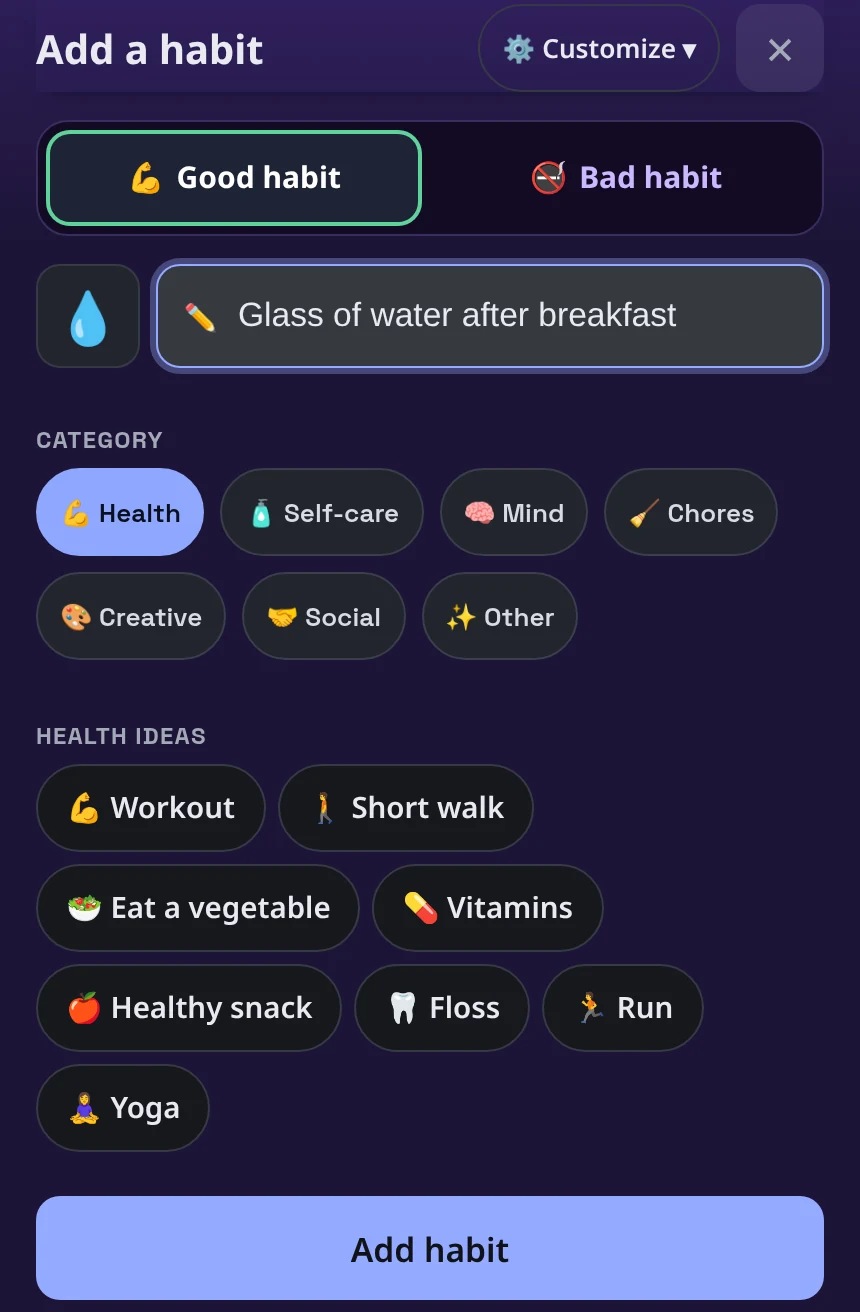
- Start small. One glass of water, one page, one stretch. Simple habits got automatic faster.
- Tie it to a cue. Pick something you already do every day: "after breakfast," "after I brush my teeth." That's how the 66-day study set up habits.
- Keep the time and place the same. A stable routine was linked with stronger habits.
- Pick something you want to do. Self-chosen, enjoyable habits did better in the research.
- Try mornings if you can. In one study, the morning version of a habit formed sooner.
- Plan for about 10 weeks. UCL researchers suggest expecting a daily habit to take around 10 weeks, and say people find it reassuring that it gets easier as you go (Gardner et al., 2012).
- Track it. Seeing your check-ins add up keeps you going through the long middle. Here's what research says about habit trackers.
- If you miss a day, just do the next one. One miss doesn't erase your progress.
How LevelHabit helps during the long middle

The hardest part of a new habit is the stretch between "this is new and exciting" and "I don't even think about it anymore." LevelHabit is a pixel-art habit tracker built to make that stretch more fun (see how it works):
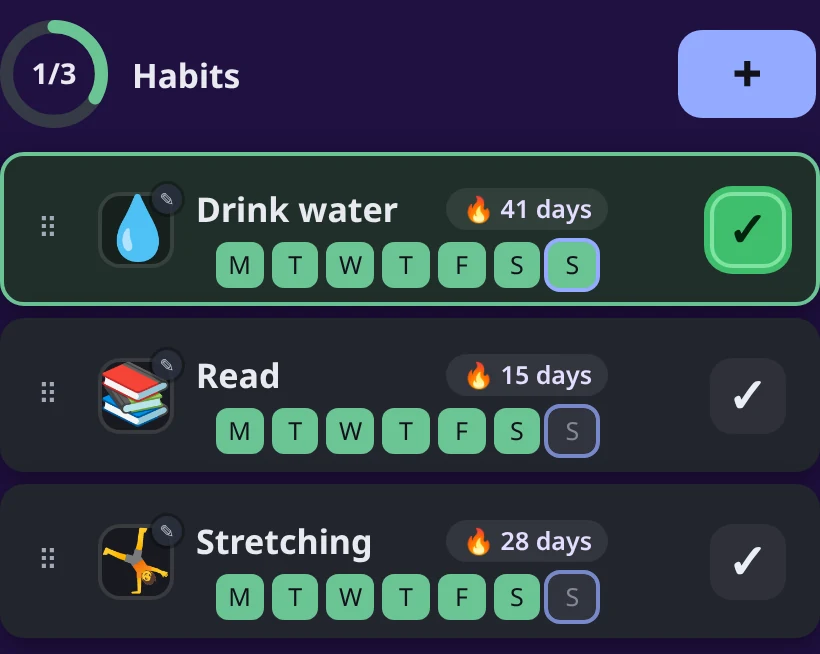
- One-tap check-ins with a 7-day history on every habit, so you can see your habit taking shape.
- XP and levels on every check-in, so there's a reward today, not just in 66 days.
- A streak on every habit, and streak flames are just for show, so a missed day never takes away your XP, levels or badges.
- Daily quests that give you a small extra goal each day.
- A hero and a pet who give you a reason to open the app that isn't just "I should."
Quick feedback and visible progress may help some people with ADHD stick with routines too. Our guide to habit trackers for ADHD goes deeper.
FAQ
How long does it take to form a habit?
In the best-known study, a median of 66 days, with a range of 18 to 254 days. A 2024 review found typical times of about two months or more. It depends on you and the habit.
Does it really take 21 days to form a habit?
No. The 21-day idea came from a 1960 self-help book about getting used to changes like a new face after surgery, not from habit research. Most habits in studies took longer.
Is 66 days a rule?
No. It's a median from one study. Some people got there in a few weeks, and others were on track to take most of a year. Treat it as a rough guide, not a deadline.
Does missing a day reset a habit?
No. Missing one day didn't materially affect habit formation in research. Lots of misses can add up, so just get back to it the next day.
Why do some habits form faster than others?
Simple habits, like drinking water, tend to get automatic sooner than bigger ones, like exercise. A stable cue, doing it consistently, and picking a habit you enjoy also seem to help.
Does it take longer with ADHD?
The studies above weren't about ADHD, so they don't give an ADHD-specific number. Small habits, clear cues and quick feedback may help, but a habit tracker isn't a treatment. If you think you might have ADHD, talk to a doctor or a qualified professional.
Ready to start your next habit?
Build your hero, pick your pet, and turn the next 66 days into XP.
Sign up free · Ages 13+
Sources
- Lally, P., van Jaarsveld, C. H. M., Potts, H. W. W., & Wardle, J. (2010). How are habits formed: Modelling habit formation in the real world. European Journal of Social Psychology, 40(6), 998–1009. https://doi.org/10.1002/ejsp.674
- Singh, B., Murphy, A., Maher, C., & Smith, A. E. (2024). Time to form a habit: A systematic review and meta-analysis of health behaviour habit formation and its determinants. Healthcare, 12(23), 2488. https://doi.org/10.3390/healthcare12232488
- Buyalskaya, A., Ho, H., Milkman, K. L., Li, X., Duckworth, A. L., & Camerer, C. (2023). What can machine learning teach us about habit formation? Evidence from exercise and hygiene. Proceedings of the National Academy of Sciences, 120(17), e2216115120. https://doi.org/10.1073/pnas.2216115120
- Gardner, B., Lally, P., & Wardle, J. (2012). Making health habitual: The psychology of ‘habit-formation’ and general practice. British Journal of General Practice, 62(605), 664–666. https://pmc.ncbi.nlm.nih.gov/articles/PMC3505409/
- Gardner, B. (2012). Busting the 21 days habit formation myth. UCL Health Behaviour Research Centre blog. https://blogs.ucl.ac.uk/bsh/2012/06/29/busting-the-21-days-habit-formation-myth/
- British Psychological Society Research Digest (2010). How to form a habit. https://www.bps.org.uk/research-digest/how-form-habit
Related: Do habit trackers actually work? · Habit tracker for ADHD: a practical guide