
The Science of Self-Monitoring for Behavior Change
If you want to change a habit, one of the simplest things you can do is also one of the best studied: keep track of it. Writing down what you eat, logging your workouts or ticking off a habit each day is called self-monitoring, and it shows up again and again in research on behavior change.
Here's what self-monitoring is, why it works, what the studies actually found, and how to self-monitor in a way that helps instead of nags.
The short answer
- Self-monitoring means regularly noticing and recording your own behavior, like checking off a habit or logging a run.
- A meta-analysis of 138 studies with nearly 20,000 people found that helping people monitor their progress helped them reach their goals. It worked better when progress was physically recorded or shared (Harkin et al., 2016).
- In healthy eating and exercise programs, self-monitoring did best when it was paired with other steps like setting a specific goal and getting feedback (Michie et al., 2009).
What is self-monitoring?
Self-monitoring is the habit of paying attention to what you do and keeping a record of it. The record can be a paper diary, a note on your phone, a scale, a step counter or a habit tracker app. What matters is that you look at your behavior on purpose, often, and write it down somewhere you can see it again.
It's different from just "trying harder." Most of us are worse at remembering what we did than we think. Was that two workouts this week or three? A record answers the question without guessing.
Why self-monitoring works: the feedback loop

Psychologists often explain self-monitoring with control theory. The idea is that we steer our behavior a bit like a thermostat steers room temperature. A thermostat has a target, checks the current temperature, notices the gap and turns the heat on or off to close it. Carver and Scheier described this "discrepancy-reducing feedback loop" as a basic building block of self-regulation (Carver & Scheier, 1982).
Applied to habits, the loop looks like this:
- Goal: "Meditate five minutes a day."
- Check: You look at your tracker and see you've done it four days out of seven.
- Compare: You notice the gap between your goal and what really happened.
- Adjust: You change something, like moving meditation to right after breakfast.
Without the check step, the loop breaks. You can have a great goal and still drift, simply because you never notice the gap. Self-monitoring is the part that keeps the loop running.
What the research says about self-monitoring and behavior change
Monitoring progress helps people reach goals. Harkin and colleagues pooled 138 experiments with 19,951 people. Interventions that got people to monitor their progress more often also improved how well they reached their goals, and the bigger the jump in monitoring, the bigger the effect on goals. Two details stood out: effects were larger when progress was reported to someone else or made public, and when it was physically recorded instead of just kept in mind (Harkin et al., 2016).
Self-monitoring works best as part of a set. Michie and colleagues looked at 122 evaluations of healthy eating and physical activity programs with 44,747 people. Self-monitoring explained more of the difference between programs than any other technique they coded. Programs that combined self-monitoring with at least one related step, such as forming an intention, setting a specific goal, getting feedback on performance or reviewing goals, worked better than programs without that combination (Michie et al., 2009).
The link shows up in weight loss too, with caveats. A systematic review of 22 weight-loss studies looked at tracking diet, exercise and weight. The reviewers consistently found a significant link between self-monitoring and weight loss. They also rated the evidence as weak, partly because many samples were small and not diverse, and because most studies relied on people's own reports (Burke et al., 2011).
So the honest summary is: self-monitoring is one of the most reliable tools we have for changing behavior, but it isn't magic on its own. It works best with a clear goal and some kind of feedback.
Why seeing your progress matters

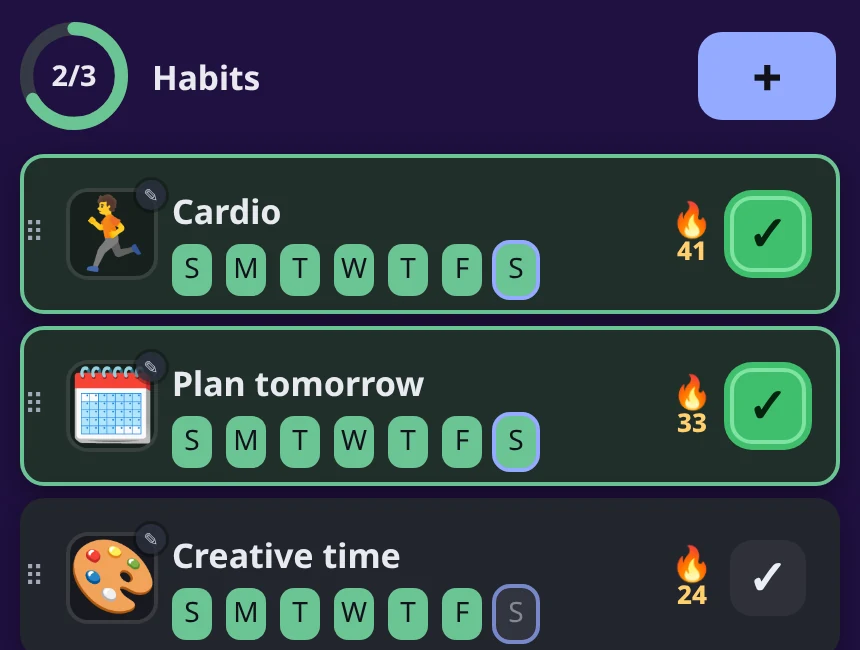
A record you never look at doesn't do much. The feedback loop needs you to see the gap. That's why a quick visual summary, like a row of checked days, a streak count or a progress bar, can be so useful. It turns a pile of data into an answer you can read in a second: "I'm on track" or "I've slipped this week."
Seeing progress can also be motivating by itself. Small wins that you can actually see make it easier to keep going, which is part of why gamification often adds points or levels on top of a simple log.
How to self-monitor well
- Track the behavior, not just the result. "Walked 20 minutes" is something you control every day. Results like weight or test scores move slowly and depend on many things.
- Pick a few things. Two or three habits are easier to log honestly than ten. You can add more once logging feels automatic.
- Log it right away. Recording soon after the habit is more accurate and turns the check-in into part of the routine.
- Write it down somewhere you'll see it. Research found that physically recording progress worked better than keeping it in your head.
- Set a specific goal to compare against. "Exercise more" gives you nothing to measure. "Cardio three times a week" does.
- Review once a week. Look back at the week, notice patterns, and adjust one thing. That's the "adjust" step of the loop.
- Share it if that helps you. Telling a friend or reporting your progress to someone was linked to bigger effects in the research.
Common self-monitoring mistakes
- Tracking too much. A long, detailed log gets tiring fast, and people tend to stop.
- Logging without looking. If you never review the record, you skip the part that changes behavior.
- Treating a bad week as failure. The point of a record is information, not judgment. Missing one day won't break your habit.
- Fudging the numbers. A record you can't trust can't guide you. Honest data beats a perfect-looking streak.
How LevelHabit helps you self-monitor
LevelHabit is a pixel-art RPG habit tracker, and it's built around a quick check-in. Each habit shows a row of day pills for the week and a streak count, so you can see at a glance how your week is going. Checking off a habit takes one tap and earns XP right away, which fills your hero's level bar and gives you instant feedback.
You create your own hero, pick a pet, and keep your list short: start with two or three habits and add more once they stick. A daily quest gives you a small, specific goal for the day.
If you have ADHD, a fast check-in and visible progress like this may help you keep track of habits without a lot of effort. It isn't a treatment, though. If you think you might have ADHD, talk to a doctor or a qualified professional. You can also read more about choosing a habit tracker for ADHD.
Key takeaways
- Self-monitoring means regularly noticing and recording your own behavior.
- It works as a feedback loop: set a goal, check where you are, notice the gap and adjust.
- Across 138 studies, monitoring progress helped people reach goals, especially when progress was written down or shared.
- It works best with a specific goal and feedback, and the weight-loss evidence is promising but still weak.
- Track a few behaviors, log right away, and review once a week.
FAQ
What is self-monitoring in behavior change?
It's the practice of observing and recording your own behavior, such as logging habits, meals or workouts, so you can compare what you do with what you want to do.
Does self-monitoring really work?
Research suggests it does for many people. A meta-analysis of 138 studies found that monitoring progress improved goal attainment, and reviews of diet, exercise and weight-loss programs link self-monitoring with better results. How well it works depends on the person and how it's done.
What should I self-monitor?
Start with two or three specific behaviors you control each day, like a short walk, reading or making your bed. Behaviors are easier to track honestly than slow-moving results.
How often should I review my tracking?
Log each habit when you do it, and take a few minutes once a week to look back, spot patterns and adjust one thing.
Start tracking today
Build your hero, pick your pet, and see your progress every time you check off a habit.
Sign up free · Ages 13+
Sources
- Harkin, B., Webb, T. L., Chang, B. P. I., Prestwich, A., Conner, M., Kellar, I., Benn, Y., & Sheeran, P. (2016). Does monitoring goal progress promote goal attainment? A meta-analysis of the experimental evidence. Psychological Bulletin, 142(2), 198–229. https://doi.org/10.1037/bul0000025
- Michie, S., Abraham, C., Whittington, C., McAteer, J., & Gupta, S. (2009). Effective techniques in healthy eating and physical activity interventions: A meta-regression. Health Psychology, 28(6), 690–701. https://doi.org/10.1037/a0016136
- Burke, L. E., Wang, J., & Sevick, M. A. (2011). Self-monitoring in weight loss: A systematic review of the literature. Journal of the American Dietetic Association, 111(1), 92–102. https://doi.org/10.1016/j.jada.2010.10.008
- Carver, C. S., & Scheier, M. F. (1982). Control theory: A useful conceptual framework for personality-social, clinical, and health psychology. Psychological Bulletin, 92(1), 111–135. https://doi.org/10.1037/0033-2909.92.1.111
Related: Do habit trackers actually work? · RPG habit trackers · How long does it take to form a habit? · The benefits of habit tracking (beyond streaks) · Why pixel art makes progress feel good