
RPG Habit Trackers: Turning Chores Into Quests
Some chores aren't hard. They're just boring. Making the bed, doing ten minutes of cardio or planning tomorrow takes almost no skill, but it's easy to put off because nothing happens when you do it. Games have the opposite problem: people happily spend hours on tasks that are basically chores with a progress bar on top.
An RPG habit tracker borrows that trick. Here's what an RPG habit tracker is, why role-playing game ideas like quests, XP and a hero can make small tasks easier to start, what the research says, and how to turn your own chores into quests.
The short answer
- An RPG habit tracker turns your real habits into a role-playing game: you have a hero, habits work like quests, and finishing them earns XP that levels you up.
- Research on games suggests people enjoy them most when they feel in control and capable (Ryan et al., 2006), and small, close goals can build skill and interest better than distant ones (Bandura & Schunk, 1981).
- A hero you made yourself may matter too. In one 3-week study, people who customized their avatar dropped out less often than people given a generic one (Birk & Mandryk, 2018).
What is an RPG habit tracker?
A regular habit tracker is a checklist: you tick a box and see a streak. An RPG habit tracker keeps the checklist but wraps it in the parts of a role-playing game that make progress feel real:
- A hero you design, who stands in for you
- Quests, which are your habits and daily goals
- XP and levels that grow every time you finish something
- A companion, like a pet, that comes along for the ride
- Adventures and rewards that give you something to look forward to
Your chores don't change. The dishes are still the dishes. But each one now moves a bar, and your hero gets a little stronger every day you show up. It's one form of gamification, with a story and a character added on top.
Why quests and XP can make chores easier
Three findings help explain why this works for a lot of people.
Games feel good when you feel capable and in charge. Across four studies, researchers found that players enjoyed games more and wanted to keep playing when the game gave them a sense of competence (getting better at something) and autonomy (making their own choices). In online games, a sense of connection to others also predicted enjoyment (Ryan et al., 2006). XP and levels are a simple way to show competence. Choosing your own habits and your own hero gives you the autonomy.
Small, close goals beat far-off ones. In a classic experiment, children who struggled with math worked through lessons with either small step-by-step goals, one big distant goal, or no goal. The step-by-step group learned faster, felt more confident and even became more interested in math. The distant goal had no clear effect (Bandura & Schunk, 1981). A daily quest is exactly that kind of small, close goal.
Tracking progress helps you reach goals. A meta-analysis of 138 studies with nearly 20,000 people found that prompting people to monitor their progress helped them reach their goals, especially when the progress was physically recorded (Harkin et al., 2016). An XP bar is progress tracking you can actually see.
Why your hero matters
The "role-playing" part isn't just decoration. Research suggests that the character you play can change how motivated you feel.
In a study of 126 players, people who identified more with their avatar (because it looked like them, felt like them, or was who they'd like to be) reported more enjoyment, more effort and more sense of choice. They also kept playing longer when the game had no set end (Birk et al., 2016).
A follow-up study went beyond games. 250 people were asked to do a one-minute breathing exercise every day for three weeks. Some used a generic avatar, and others customized their own. The people with a customized avatar dropped out less and logged in more consistently (Birk & Mandryk, 2018).
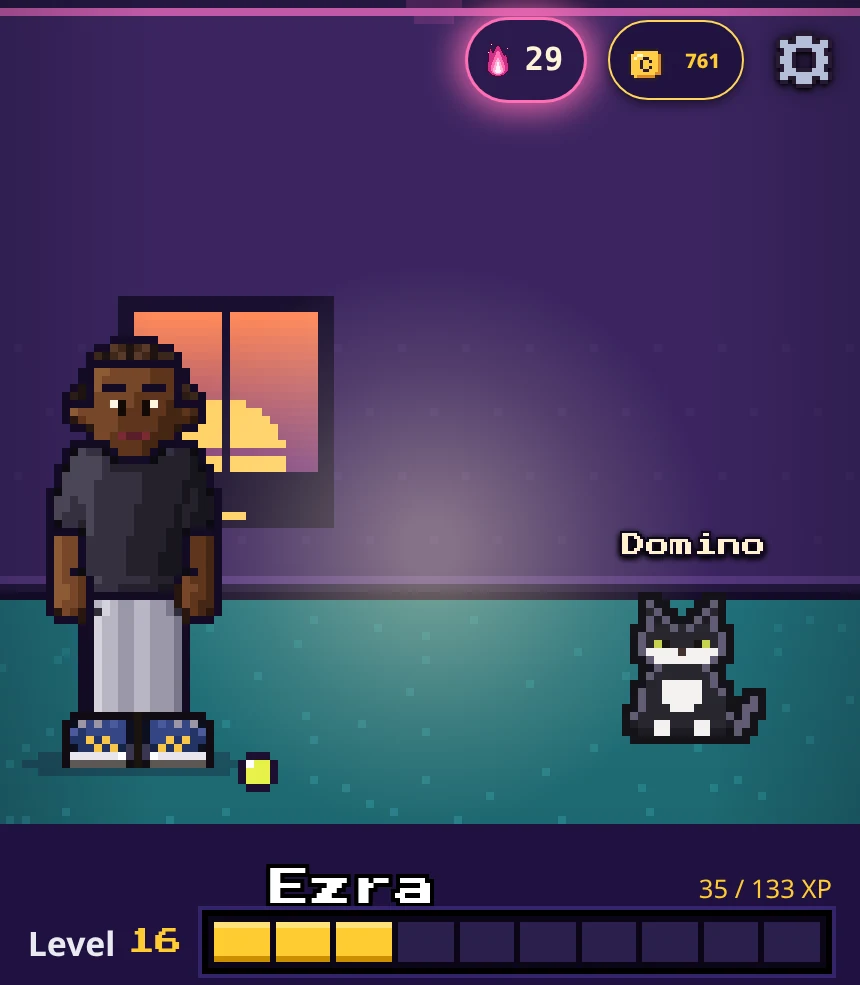
That's the idea behind building a hero in a habit app: when the character feels like yours, checking in feels less like homework and more like visiting someone you care about.
How to turn chores into quests
- Make each quest tiny and clear. "Clean the kitchen" is vague. "Wipe the counters" is a quest you can finish in five minutes.
- Start with two or three. A new game doesn't throw every quest at you on day one. Pick a few habits and add more once they feel easy.
- Tie quests to a moment in your day. Habits form by repeating them in the same situation, like "make the bed right after I get up."
- Check in right away. The payoff of XP works best the moment you finish, not hours later.
- Let your hero carry the story. Give your hero a name and a look you like. It's easier to show up for a character you care about.
- Don't panic over a missed day. Heroes have bad days too. One missed day won't break your habit, so just pick up the next quest.
What to look for in an RPG habit tracker
- Instant feedback, like XP that shows up as soon as you check off a habit
- A hero you can customize so it actually feels like yours
- Daily quests or small goals so each day has a clear target
- Visible long-term progress, such as levels that keep climbing
- Kind handling of missed days, so one slip doesn't wipe out your motivation
- Simple, fast check-ins. If logging a habit takes longer than doing it, the game gets in the way
When the game gets in the way
RPG mechanics are a tool, not the goal. A few things to watch for:
- Checking off quests you didn't do. The XP stops meaning anything. The real habit is the point.
- Too many quests. A huge quest log feels like a second job. Keep it short.
- Chasing rewards instead of habits. If you only open the app for the loot, pick quests you actually care about.
How LevelHabit works as an RPG habit tracker
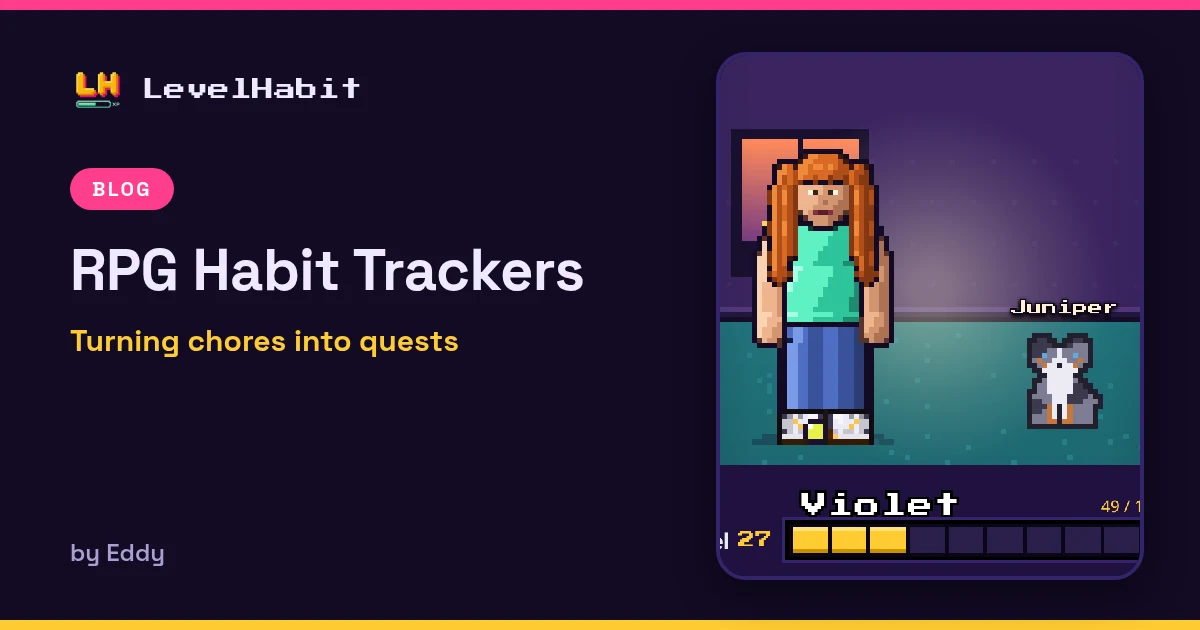
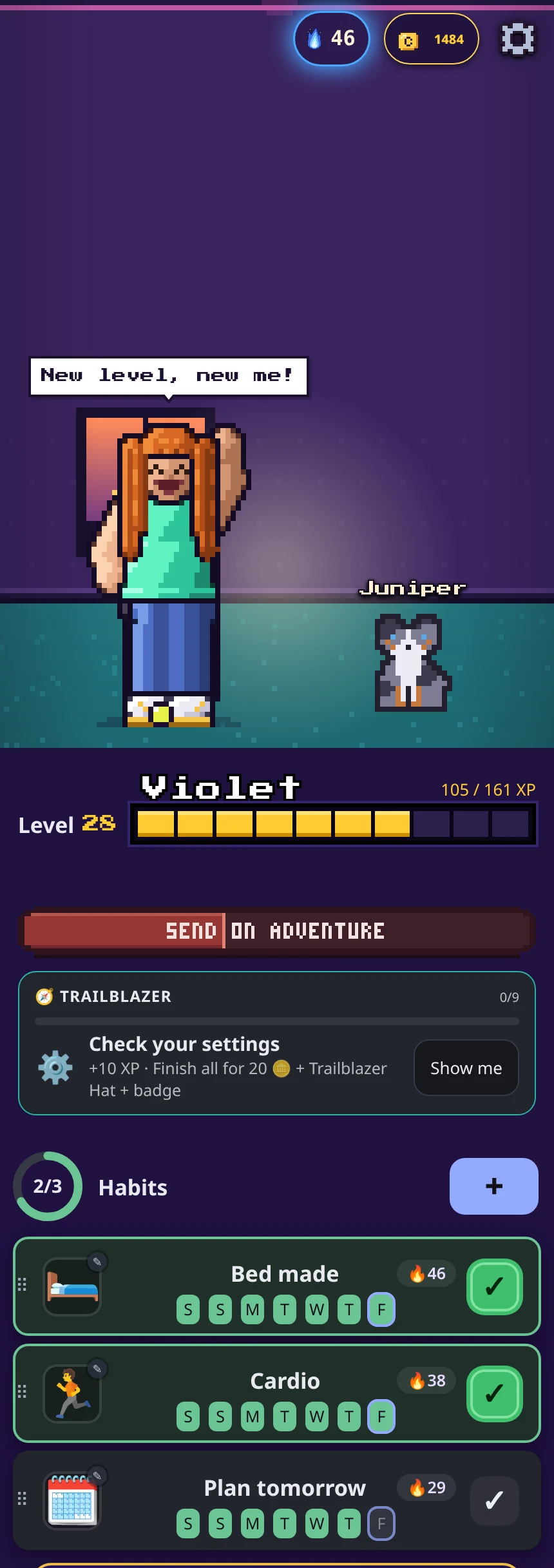
LevelHabit is a habit tracker built like a pixel-art RPG. You create a hero, pick a pet, and every habit you check off earns XP. XP fills your level bar, and your hero and pet hang out in a room that's yours.
A new daily quest gives each day a small goal, and adventures let your hero head out to explore with your pet. Missed a day? Your streak starts over, but your weekly history still shows every day you did show up.
If you have ADHD, quick feedback and small goals like these may help make everyday tasks feel more rewarding. It isn't a treatment, though. If you think you might have ADHD, talk to a doctor or a qualified professional.
Key takeaways
- An RPG habit tracker turns habits into quests, gives you XP and levels, and lets you play as a hero.
- Games tend to motivate when they make you feel capable and in control, and small close goals work better than distant ones.
- Customizing your own hero was linked to less dropout in a three-week daily program.
- Keep quests tiny, start with a few, and check in right away.
FAQ
What is an RPG habit tracker?
It's a habit app that works like a role-playing game. You play as a hero, your habits act as quests, and completing them earns XP that levels your hero up.
Do RPG habit trackers actually work?
Research suggests the pieces they use can help: tracking progress supports goal attainment, small goals build confidence, and a customized avatar was linked to less dropout. Results still depend on the person and on how the app is designed.
Is an RPG habit tracker good for ADHD?
Instant rewards and small, clear quests may help some people with ADHD get started on tasks. It's a tool, not a treatment.
How do I turn chores into quests?
Break each chore into one small, clear action, attach it to a set moment in your day, and check it off right after you finish to earn your XP.
Start your first quest
Build your hero, pick your pet, and earn XP for every habit you check off.
Sign up free · Ages 13+
Sources
- Ryan, R. M., Rigby, C. S., & Przybylski, A. (2006). The motivational pull of video games: A self-determination theory approach. Motivation and Emotion, 30(4), 344–360. https://doi.org/10.1007/s11031-006-9051-8
- Bandura, A., & Schunk, D. H. (1981). Cultivating competence, self-efficacy, and intrinsic interest through proximal self-motivation. Journal of Personality and Social Psychology, 41(3), 586–598. https://doi.org/10.1037/0022-3514.41.3.586
- Harkin, B., Webb, T. L., Chang, B. P. I., Prestwich, A., Conner, M., Kellar, I., Benn, Y., & Sheeran, P. (2016). Does monitoring goal progress promote goal attainment? A meta-analysis of the experimental evidence. Psychological Bulletin, 142(2), 198–229. https://doi.org/10.1037/bul0000025
- Birk, M. V., Atkins, C., Bowey, J. T., & Mandryk, R. L. (2016). Fostering intrinsic motivation through avatar identification in digital games. Proceedings of the 2016 CHI Conference on Human Factors in Computing Systems, 2982–2995. https://doi.org/10.1145/2858036.2858062
- Birk, M. V., & Mandryk, R. L. (2018). Combating attrition in digital self-improvement programs using avatar customization. Proceedings of the 2018 CHI Conference on Human Factors in Computing Systems, 1–15. https://doi.org/10.1145/3173574.3174234
Related: What is gamification? · Do habit trackers actually work? · Habit tracker for ADHD · XP for real life: how leveling up motivates you · Why pixel art makes progress feel good