
What Is Gamification and Why It Can Help Habits
Some habits are easy to care about and hard to actually do. You know drinking water, stretching or planning tomorrow is good for you, but "good for you" doesn't always get you off the couch. Games, on the other hand, are great at making people come back day after day.
That's the idea behind gamification: borrowing what makes games motivating and using it for real life. Here's what gamification actually means, what the research says about the gamification of habits, which game elements seem to do the heavy lifting, and how to use it without it turning into a gimmick.
The short answer
- Gamification means using game design elements in non-game contexts, like points, levels and avatars in a habit app (Deterding et al., 2011).
- In a meta-analysis of 16 randomized trials, gamified interventions had a small-to-medium positive effect on physical activity (Mazeas et al., 2022).
- It isn't magic. Results depend on which game elements are used, because different elements meet different psychological needs (Sailer et al., 2017).
What is gamification?
The most widely cited definition comes from a 2011 paper by game researchers: gamification is "the use of game design elements in non-game contexts" (Deterding et al., 2011).
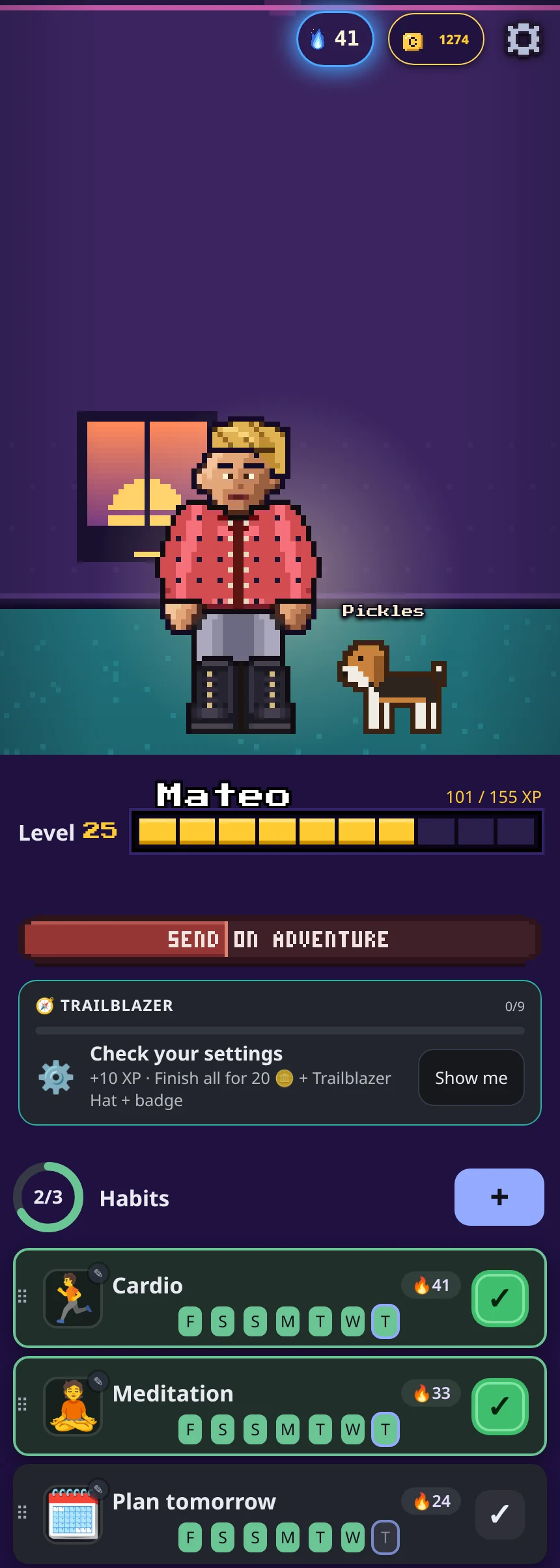
The key word is elements. A gamified habit app isn't a full video game. It takes pieces of games, such as experience points (XP), levels, quests, avatars, progress bars and rewards, and attaches them to things you already want to do. Your workout is still a workout. It just also fills a bar.
Common game elements you'll see in habit apps:
- Points and XP for every completed habit
- Levels that show long-term progress
- Progress bars that make the next goal visible
- Avatars you create and grow over time
- Quests and challenges that give the day a small goal
- Streaks that count how many days in a row you showed up
Does gamification of habits actually work?
The research is promising, with some honest caveats.
A 2022 meta-analysis pooled 16 randomized controlled trials with 2,407 participants and found that gamified interventions had a small-to-medium effect on physical activity. The effect was bigger when compared with doing nothing, and smaller (but still positive) when compared with similar programs that weren't gamified. In studies that followed people after the program ended, about 14 weeks later on average, the effect was smaller but still there. Results were similar for adults and adolescents (Mazeas et al., 2022).
A large randomized trial gave 602 adults with overweight or obesity a step goal plus points and levels for 24 weeks. Compared with a control group, people in the gamified groups walked more each day, with gains of about 640 to 920 extra steps per day depending on the version. After the game ended, activity dropped in every group, but one version still stayed ahead of the control group during the 12-week follow-up (Patel et al., 2019).
A systematic review of gamification for health and wellbeing found that 59% of the results were positive and 41% were mixed, with the clearest support for health behaviors. The authors also pointed out that the quality of the evidence was mostly moderate or lower, so more good studies are needed (Johnson et al., 2016).
So the fair summary is: gamification can help people do more of a healthy behavior, especially while they're using it. It isn't a guarantee, and how it's designed matters a lot.
Why game elements can be motivating
One study looked closely at which game elements do what. Researchers had people work through a task with different sets of game elements and measured how it affected their psychological needs (Sailer et al., 2017):
- Badges, leaderboards and performance graphs boosted people's sense of competence and made the task feel more meaningful.
- Avatars, a meaningful story and teammates boosted the feeling of social relatedness, the sense of being connected to something.
Their conclusion is a useful one: gamification isn't effective just because it's there. Specific game elements have specific effects. Feedback that shows you're getting better builds a sense of progress. A character you care about and a story give the effort a "why."
That fits with how habits form in the first place: by repeating something in a consistent situation, over and over. Gamification doesn't replace the repetition. It gives you a reason to come back for the next one.
Game elements that can help your habits
- Instant feedback. Points or XP that show up the moment you finish a habit make the payoff immediate, even when the real benefit is months away.
- Visible progress. Levels and progress bars show how far you've come, which is easy to forget on a hard day.
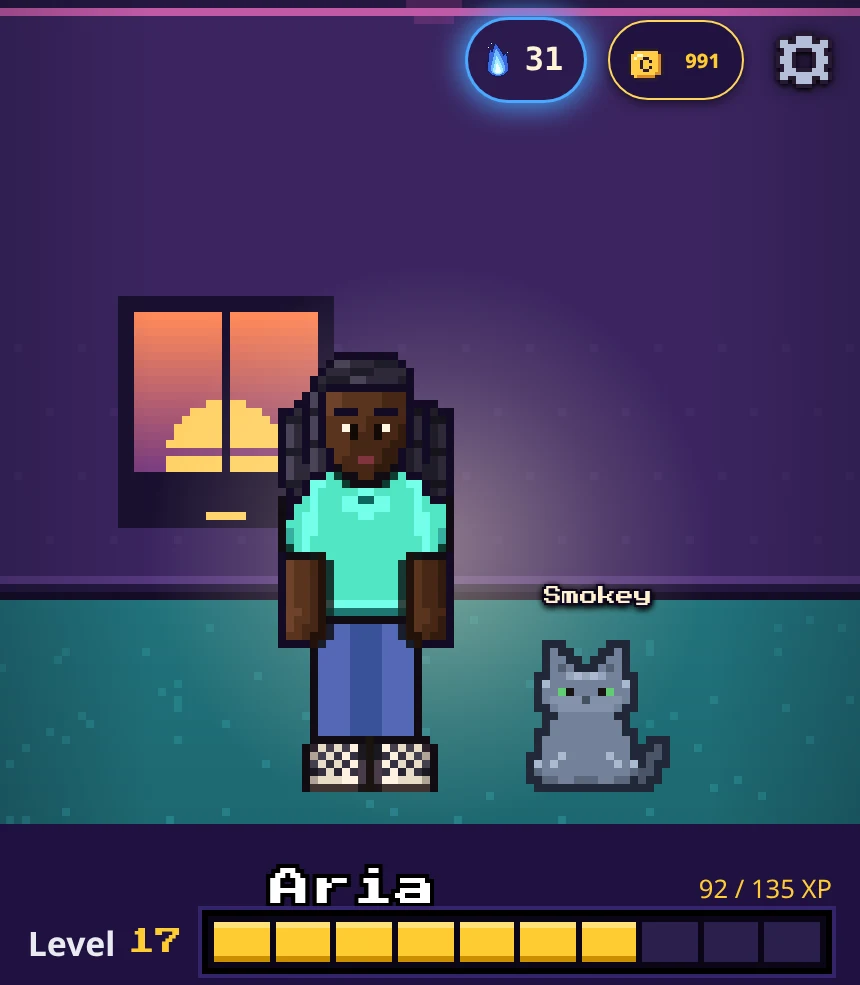
- A character to care about. An avatar or pet that grows with you turns "do the dishes" into part of a bigger story.
- Small, clear goals. A daily quest gives you one specific target instead of a vague "be better."
- A little variety. New quests, items and rewards keep the routine from feeling stale.
When gamification backfires
Game elements can also get in the way. A few things to watch for:
- The game replaces the goal. If you're tapping "done" without doing the habit, the points stop meaning anything. Keep the habit itself as the point.
- Streak panic. A streak that drops to zero can feel like losing everything, and that can make people quit. One missed day won't break your habit.
- Too much at once. Ten new habits with ten new rewards is overwhelming. Start with two or three.
- Fading after the game ends. In the step study, activity dropped once the game stopped. Choose a system you'll actually enjoy using for the long run.
How LevelHabit uses gamification
LevelHabit is a habit tracker built like a pixel-art RPG. You create a hero, pick a pet, and every habit you check off earns XP. XP fills your level bar, levels show your long-term progress, and your hero and pet hang out in a room that's yours.
A new daily quest gives each day a small goal, and adventures let you send your hero off to explore with your pet. And if you miss a day, the streak counter starts over, but your 7-day history still shows all the days you did show up.
If you have ADHD, quick feedback like this may help make everyday tasks feel more rewarding. It isn't a treatment, though. If you think you might have ADHD, talk to a doctor or a qualified professional.
FAQ
What is the gamification of habits?
It means adding game elements, like points, levels, avatars and quests, to habit building so that doing your habits feels more rewarding and progress is easier to see.
Is gamification good for building habits?
Research suggests it can help. A meta-analysis of randomized trials found a small-to-medium positive effect on physical activity. Results vary depending on how it's designed.
Does gamification still work after the novelty wears off?
Effects tend to shrink over time, and they can drop when the game ends. Picking a system you enjoy and tying habits to consistent daily cues can help them last.
What game elements work best?
It depends on what you need. Progress feedback like levels and graphs can build a sense of competence, while avatars and a story can make the effort feel connected to something bigger.
Turn your habits into a game
Build your hero, pick your pet, and earn XP for every habit you check off.
Sign up free · Ages 13+
Sources
- Deterding, S., Dixon, D., Khaled, R., & Nacke, L. (2011). From game design elements to gamefulness: Defining "gamification." Proceedings of the 15th International Academic MindTrek Conference, 9–15. https://doi.org/10.1145/2181037.2181040
- Mazeas, A., Duclos, M., Pereira, B., & Chalabaev, A. (2022). Evaluating the effectiveness of gamification on physical activity: Systematic review and meta-analysis of randomized controlled trials. Journal of Medical Internet Research, 24(1), e26779. https://doi.org/10.2196/26779
- Patel, M. S., Small, D. S., Harrison, J. D., et al. (2019). Effectiveness of behaviorally designed gamification interventions with social incentives for increasing physical activity among overweight and obese adults across the United States: The STEP UP randomized clinical trial. JAMA Internal Medicine, 179(12), 1624–1632. https://doi.org/10.1001/jamainternmed.2019.3505
- Johnson, D., Deterding, S., Kuhn, K.-A., Staneva, A., Stoyanov, S., & Hides, L. (2016). Gamification for health and wellbeing: A systematic review of the literature. Internet Interventions, 6, 89–106. https://doi.org/10.1016/j.invent.2016.10.002
- Sailer, M., Hense, J. U., Mayr, S. K., & Mandl, H. (2017). How gamification motivates: An experimental study of the effects of specific game design elements on psychological need satisfaction. Computers in Human Behavior, 69, 371–380. https://doi.org/10.1016/j.chb.2016.12.033
Related: Do habit trackers actually work? · Habit tracker for ADHD · Why missing one day won't break your habit