
Why Pixel Art Makes Progress Feel Good
A row of tiny squares fills up. A little hero takes one more step. A pixel cat curls up next to them. It's not much, but it feels good. Why?
Pixel art has a way of making small progress easy to see and fun to look at. In this post we look at what research says about visible progress, simple visuals, nostalgia and avatars, and how a pixel art habit tracker may help you keep coming back.
The short answer
- Seeing progress helps. A large review found that monitoring progress toward a goal helped people reach it, especially when progress was recorded or made visible (Harkin et al., 2016).
- Getting closer pulls you forward. People tend to speed up as a goal gets near, like coffee-card customers who bought more often as they got close to a free drink (Kivetz et al., 2006).
- Simple visuals are easy on the brain. Things that are easy to process tend to feel more pleasing (Reber et al., 2004). Clean, chunky pixel art is very easy to read at a glance.
- A hero can make it personal. The look of an avatar can shape how people act (Yee & Bailenson, 2007), so a hero who grows with you can make progress feel like yours.
Progress you can see is progress you keep
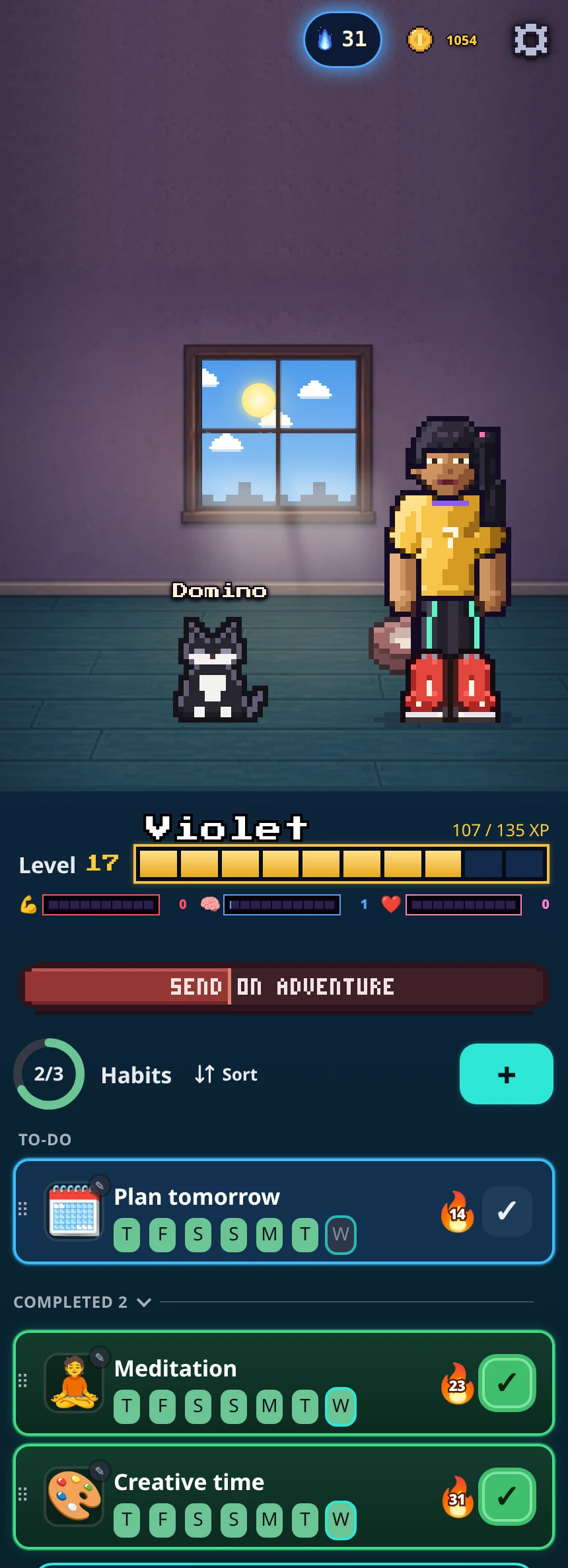
Most habits are invisible. You meditate for five minutes and nothing around you changes. That's a problem, because a habit gives you its biggest payoff weeks later, while the effort happens today.
Tracking closes that gap. A meta-analysis of 138 studies with nearly 20,000 people found that prompting people to monitor their progress helped them reach their goals. The effect was larger when progress was physically recorded or shared, not just kept in their heads (Harkin et al., 2016).
Pixel art turns that record into something you actually want to look at. A bar made of chunky blocks shows every single check-in as its own little square. You can count them. You can see the next one waiting. We dig into the research on tracking in the science of self-monitoring.
The almost-full bar effect
There's a reason an almost-full bar is so hard to walk away from. In a study of a café reward card, customers bought coffee more often the closer they got to their free drink. Researchers call this the goal-gradient effect (Kivetz et al., 2006).
A head start helps too. In a car wash study, customers got a card needing 8 stamps, or a card needing 10 stamps with 2 already filled in. Both needed 8 washes, but more people finished the card that looked partly done: 34% versus 19% (Nunes & Drèze, 2006).
An XP bar works the same way. Every habit you check off fills a few more blocks, and once you can see the level-up coming, one more habit feels very doable. For more on that, read XP for real life.
Why simple, chunky art feels good
Pixel art is made of a small number of big, clear shapes. That simplicity is a feature. Researchers have proposed that the easier something is to take in, the more pleasing it tends to feel. They call this processing fluency (Reber et al., 2004).
For a habit tracker, that matters. You want to open the app, see where you stand in a second, check something off and get on with your day. Bold pixel shapes, bright colors and clear bars make that quick glance easy, even on a busy or low-energy day.
A little nostalgia goes a long way
For a lot of people, pixel art brings back old games, rainy afternoons and the feeling of finally beating a level. That warm, looking-back feeling is nostalgia, and it's been studied. In a series of studies, nostalgia was linked to more positive mood, stronger feelings of connection to others and better self-regard (Wildschut et al., 2006).
Nobody needs to have grown up with old games to enjoy pixel art, though. Plenty of people just like how cozy and playful it looks. Either way, a habit tracker that feels like a game you like is easier to open than one that feels like a spreadsheet.
Your hero, your progress
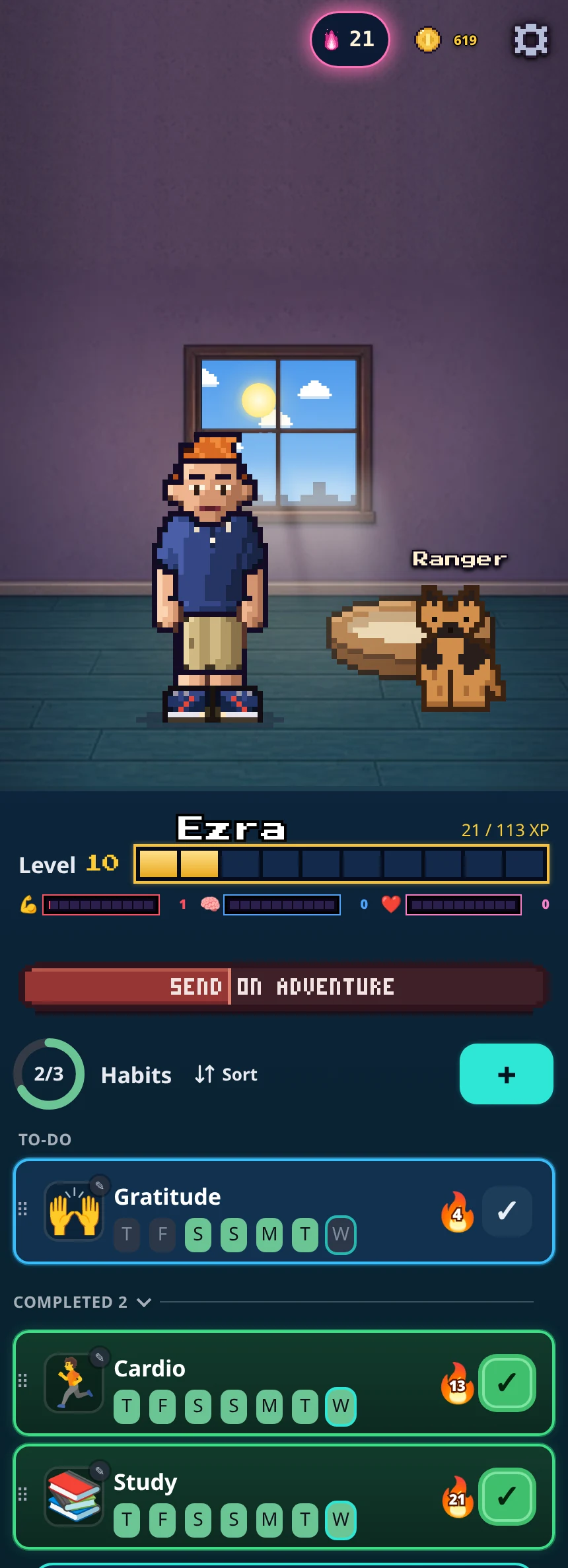
Progress feels different when it belongs to someone. In virtual-world experiments, people given more attractive avatars walked closer to others and shared more about themselves, and people given taller avatars negotiated more confidently. Researchers called this the Proteus effect (Yee & Bailenson, 2007).
That doesn't mean a pixel hero will change your life. But building a character that looks like you, or like who you want to be, can make each check-in feel like part of your own story instead of a box on a list. Add a pet who hangs out with you, and your habits suddenly have a home.
How to make your progress feel good
- Make it visible. Track your habits somewhere you can see them every day.
- Use small units. Count each check-in on its own, so progress shows up fast.
- Show the next step. A bar that's almost full is a great reason to do one more habit.
- Make it yours. Pick a look, colors or a character you actually enjoy.
- Celebrate little wins. A quick reward right after a habit helps while it's still new. See the habit loop for why.
Pixel progress in LevelHabit
LevelHabit is a habit tracker built like a small pixel-art RPG. You design your own hero, pick a pet, and every habit you check off earns XP that fills your level bar block by block. Your streak flame ticks up, your room stays cozy, and your pet keeps you company. That steady, visible feedback may help on the days when motivation is low, including for people with ADHD.
Key takeaways
- Monitoring progress helps people reach goals, especially when progress is recorded and visible.
- People tend to speed up as a goal gets close, so an almost-full bar can pull you forward.
- Simple, easy-to-read visuals tend to feel more pleasing, and pixel art is easy to read.
- Nostalgia is linked to better mood, and a hero you made can make progress feel personal.
Build your hero, pick your pet, and watch your progress fill up one pixel at a time.
Sign up free · Ages 13+
Sources
- Harkin, B., Webb, T. L., Chang, B. P. I., Prestwich, A., Conner, M., Kellar, I., Benn, Y., & Sheeran, P. (2016). Does monitoring goal progress promote goal attainment? A meta-analysis of the experimental evidence. Psychological Bulletin, 142(2), 198–229. https://doi.org/10.1037/bul0000025
- Kivetz, R., Urminsky, O., & Zheng, Y. (2006). The goal-gradient hypothesis resurrected: Purchase acceleration, illusionary goal progress, and customer retention. Journal of Marketing Research, 43(1), 39–58. https://doi.org/10.1509/jmkr.43.1.39
- Nunes, J. C., & Drèze, X. (2006). The endowed progress effect: How artificial advancement increases effort. Journal of Consumer Research, 32(4), 504–512. https://doi.org/10.1086/500480
- Reber, R., Schwarz, N., & Winkielman, P. (2004). Processing fluency and aesthetic pleasure: Is beauty in the perceiver's processing experience? Personality and Social Psychology Review, 8(4), 364–382. https://doi.org/10.1207/s15327957pspr0804_3
- Wildschut, T., Sedikides, C., Arndt, J., & Routledge, C. (2006). Nostalgia: Content, triggers, functions. Journal of Personality and Social Psychology, 91(5), 975–993. https://doi.org/10.1037/0022-3514.91.5.975
- Yee, N., & Bailenson, J. (2007). The Proteus effect: The effect of transformed self-representation on behavior. Human Communication Research, 33(3), 271–290. https://doi.org/10.1111/j.1468-2958.2007.00299.x
Related: XP for real life · Self-monitoring · RPG habit trackers · How virtual pets can keep you coming back