
Cues, Routines, Rewards: The Habit Loop Explained

You sit on the couch, and your hand finds your phone before you've even decided to check it. You walk into the kitchen, and suddenly you're holding a snack. Nobody planned those moments. They just happened, on cue.
That's the habit loop at work: a cue, a routine and a reward. Once you can see the three parts, you can start building loops on purpose, for the things you actually want to do. Here's what research says about each step, and a simple way to design your own.
The short answer
- Habits are cue-triggered. They grow out of repeated links between an action and the context around it, like a place, a time or the thing you just did. Once a habit forms, the context alone can set it off (Wood & Neal, 2007).
- Repetition in the same context builds them. People who repeated a daily action after the same cue, like "after breakfast," found it got more automatic over time. It took anywhere from 18 to 254 days to level off (Lally et al., 2010).
- Strong habits can outlast the reward. In a cinema, people with a strong popcorn habit ate about as much stale popcorn as fresh (Neal et al., 2011).
- You can design the loop. Pick a cue you hit every day, keep the routine tiny, and give yourself a quick reward while the habit is still new.
What is the habit loop?
The habit loop is a simple way to describe how a habit runs. It has three parts:
- Cue: the trigger. A time of day, a place, a feeling, or something you just finished doing.
- Routine: the action itself. Brushing your teeth, scrolling, stretching, reading.
- Reward: the payoff that makes the loop worth repeating. A good feeling, a sense of progress, a tiny win.
Run the loop enough times in the same setting and it starts to feel automatic. Researchers call this automaticity: the action happens with less thinking and less effort. A review of habit research describes habits as the efficient, default mode of response: what you do when you're not stopping to decide (Wood & Rünger, 2016).
Step 1: The cue
Cues are the most underrated part of the loop. Habit researchers describe habits as links between actions and the features of the context where they happen, such as physical settings and preceding actions. Once the habit is formed, noticing that context is enough to trigger the action, without needing a goal in between (Wood & Neal, 2007).
That's why "I'll read more" rarely sticks, but "after dinner, I read one page" has a real shot. The second one has a cue built in. The best cues are:
- Daily. Something that happens every day, like waking up, lunch, or getting into bed.
- Specific. "After I pour my coffee" beats "in the morning."
- Already a habit. Hooking onto something you never skip gives the new habit a free ride. That's the idea behind habit stacking.
Step 2: The routine
The routine is the part you see, so it's tempting to make it big. Don't. A small action you do every time builds the loop faster than a big one you do sometimes.
In a study from University College London, volunteers picked one eating, drinking or activity habit and did it once a day after the same cue for 12 weeks. The more consistently people did it, the better their progress fit a steady habit-building curve (Lally et al., 2010). Simple actions, like drinking water, got automatic sooner than bigger ones, like doing 50 sit-ups (Gardner et al., 2012).
So start with the smallest version that still counts. Two minutes of stretching. One page. One glass of water. You can grow it once the loop runs on its own.
Step 3: The reward
Rewards are what make you want to repeat the loop while it's still new. Early on, the routine takes effort, and a quick payoff gives your brain a reason to come back tomorrow.
Here's the twist: once a habit is strong, it leans on the cue more than the reward. In one field study, people who usually ate popcorn at the movies ate about as much stale popcorn as fresh popcorn. Their hunger and how much they liked it barely mattered. But that only happened in the cinema, the context tied to the habit. People with weaker popcorn habits ate based on how much they liked it (Neal et al., 2011).
That cuts both ways. It's why old habits can be hard to shake. It's also why a good habit, once built, can keep going on days when motivation is low.
How to design your own habit loop
- Pick one habit. Choose something you care about, not something you think you should do.
- Choose a cue you hit every day. Write it as "After I ___, I will ___."
- Shrink the routine. Make it so small you could do it on your worst day.
- Add an instant reward. A check mark, a little celebration, or watching a progress bar fill up.
- Repeat in the same place and time. Consistency is what turns the loop into autopilot.
- Give it time. The UCL researchers suggest expecting a daily habit to take around 10 weeks to form (Gardner et al., 2012). For more on that, see how long it takes to form a habit.
When the loop breaks
You'll miss a day. Everyone does. In the UCL study, missing one chance to do the habit did not materially affect the habit-building process (Lally et al., 2010). Just catch the cue next time and run the loop again. We go deeper on this in why missing one day won't break your habit.
If you keep missing, look at the cue first. It may not happen every day, or it may be too vague. Swap it for something more reliable before you blame yourself.
Build your loops in LevelHabit
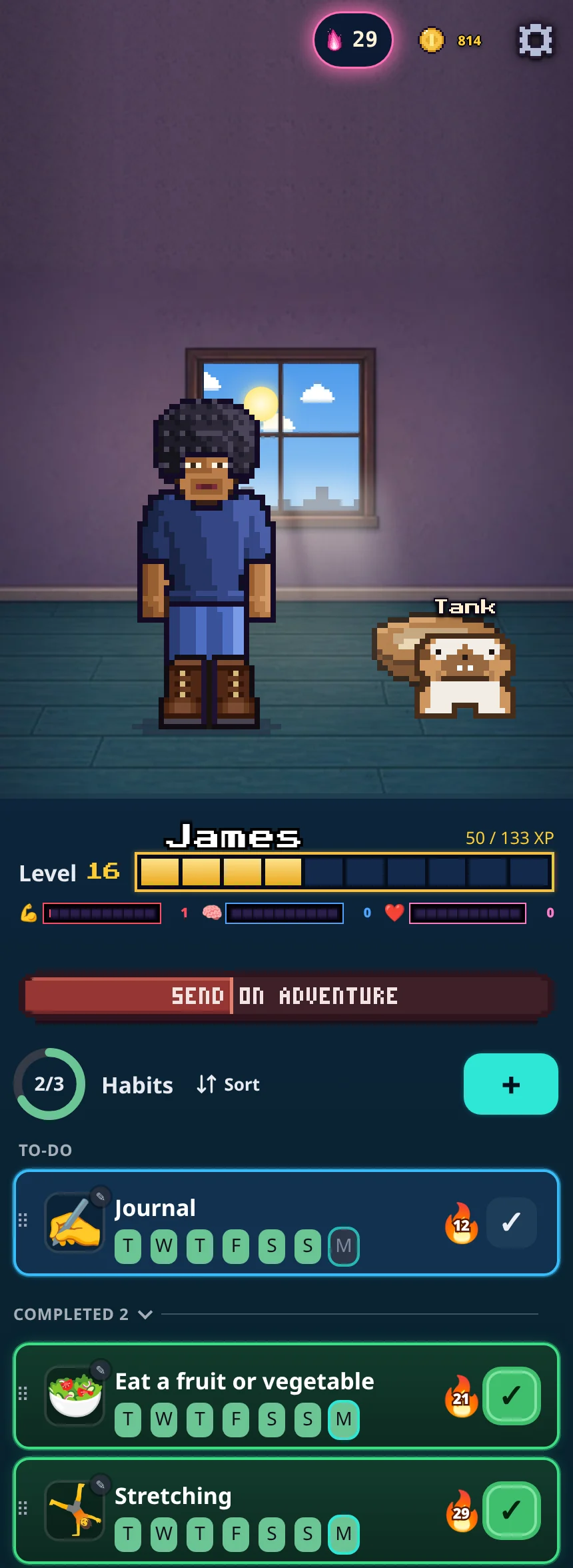
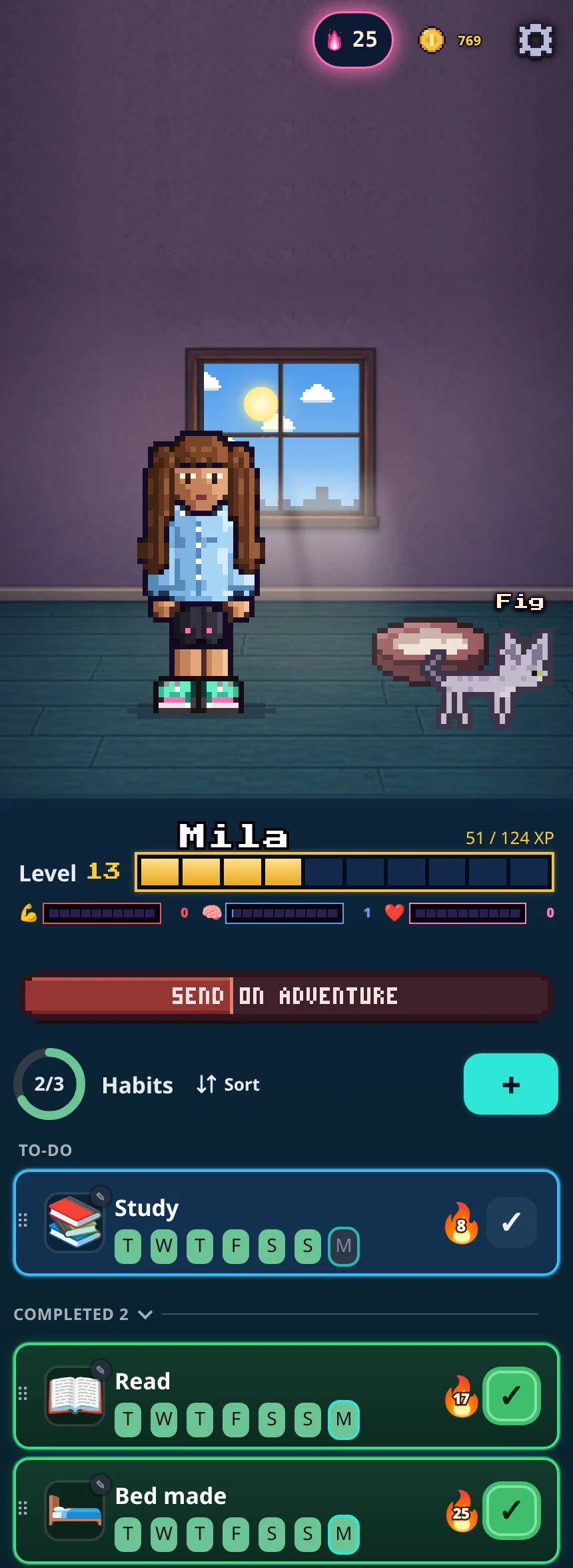
LevelHabit is a habit tracker built like a small RPG, and it's built around the reward step. Every check-in earns XP for your pixel hero, your daily streak flame ticks up, and your pet hangs out with you in your room. That quick feedback may help most in the early weeks, when the routine still takes effort.
You bring the cue. Give each habit a trigger, like stretching right after you wake up or journaling before bed, then check it off the moment you're done so the reward lands right away. For more on why instant feedback can help, read about XP for real life.
Key takeaways
- The habit loop has three parts: a cue, a routine and a reward.
- Habits are tied to context. Once formed, the cue alone can trigger the action.
- Pick a daily, specific cue and keep the routine tiny.
- Rewards matter most while a habit is new. Strong habits can keep going even when the reward fades.
- Expect a daily habit to take weeks to months, and don't panic over one missed day.
Build your hero, pick your pet, and turn your best habit loops into quests you can actually finish.
Sign up free · Ages 13+
Sources
- Wood, W., & Neal, D. T. (2007). A new look at habits and the habit-goal interface. Psychological Review, 114(4), 843–863. https://doi.org/10.1037/0033-295X.114.4.843
- Wood, W., & Rünger, D. (2016). Psychology of habit. Annual Review of Psychology, 67, 289–314. https://doi.org/10.1146/annurev-psych-122414-033417
- Lally, P., van Jaarsveld, C. H. M., Potts, H. W. W., & Wardle, J. (2010). How are habits formed: Modelling habit formation in the real world. European Journal of Social Psychology, 40(6), 998–1009. https://doi.org/10.1002/ejsp.674
- Gardner, B., Lally, P., & Wardle, J. (2012). Making health habitual: The psychology of 'habit-formation' and general practice. British Journal of General Practice, 62(605), 664–666. https://doi.org/10.3399/bjgp12X659466
- Neal, D. T., Wood, W., Wu, M., & Kurlander, D. (2011). The pull of the past: When do habits persist despite conflict with motives? Personality and Social Psychology Bulletin, 37(11), 1428–1437. https://doi.org/10.1177/0146167211419863
Related: Habit stacking · How long does it take to form a habit? · Self-monitoring · Start tiny: the two-minute habit idea