
XP for Real Life: How to Gamify Your Life With Levels
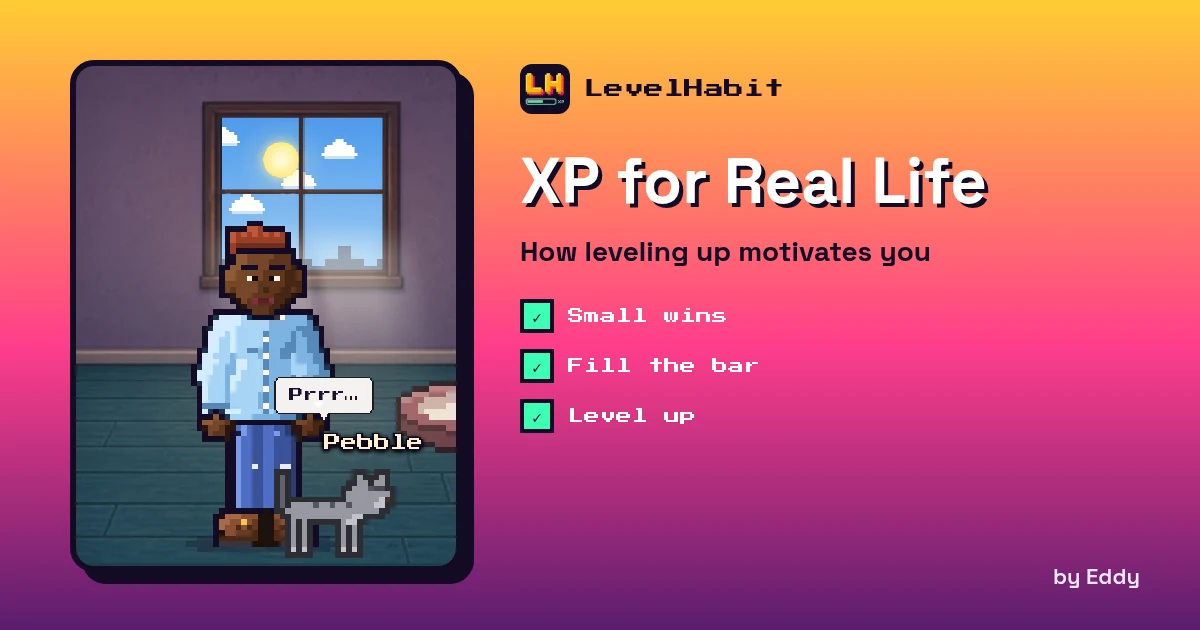
In a game, every small thing you do counts. Beat a slime, earn a little XP. Fill the bar, level up. It feels great, and it keeps you playing. Real life rarely works like that. You can go to the gym for three weeks and still feel like nothing has changed.
XP for real life is the idea of giving your everyday habits that same game feel: small points for small wins, a bar you can watch fill, and a level-up when you get there. Here's why that can work, what research says about progress and motivation, and how to set it up without letting the game take over.
The short answer
- Progress is one of the strongest motivators. In a study of nearly 12,000 work diary entries, making progress in meaningful work was the top booster of motivation and mood (Amabile & Kramer, 2011).
- People speed up near a goal. Café customers bought coffee more often as they got closer to a free one (Kivetz et al., 2006).
- A head start helps. People who felt they had already begun were more likely to finish (Nunes & Drèze, 2006).
- Points and levels can change behavior. In a 24-week trial, a game with points and levels helped adults walk more each day (Patel et al., 2019).
- It isn't magic. Game elements help some people in some settings more than others (Hamari et al., 2014).
What "XP for real life" means
XP (experience points) is how games measure progress. You don't level up from one big moment. You level up from lots of small ones that add up. Applied to real life, it looks like this:
- Small actions earn points. Drink water, stretch, read 10 pages.
- Points fill a visible bar. You can see how close you are to the next level.
- Levels mark milestones. Each one is proof that the small stuff added up.
The point isn't the number. It's making progress you can't normally see, like getting a bit fitter or a bit calmer, show up on screen today.
Why progress is so motivating
Researchers Teresa Amabile and Steven Kramer asked 238 people on 26 project teams to keep daily diaries, which gave them nearly 12,000 entries. They found what they called the progress principle: of all the things that can boost emotions, motivation and perceptions during a workday, the single most important is making progress in meaningful work. The more often people felt that progress, the better.
Their study was about work, but the lesson fits habits too. Progress fuels motivation, and small wins count. The trouble is that habit progress is usually invisible. One workout doesn't change the mirror. XP makes each small win visible right away.
The goal gradient: why a nearly full bar pulls you in
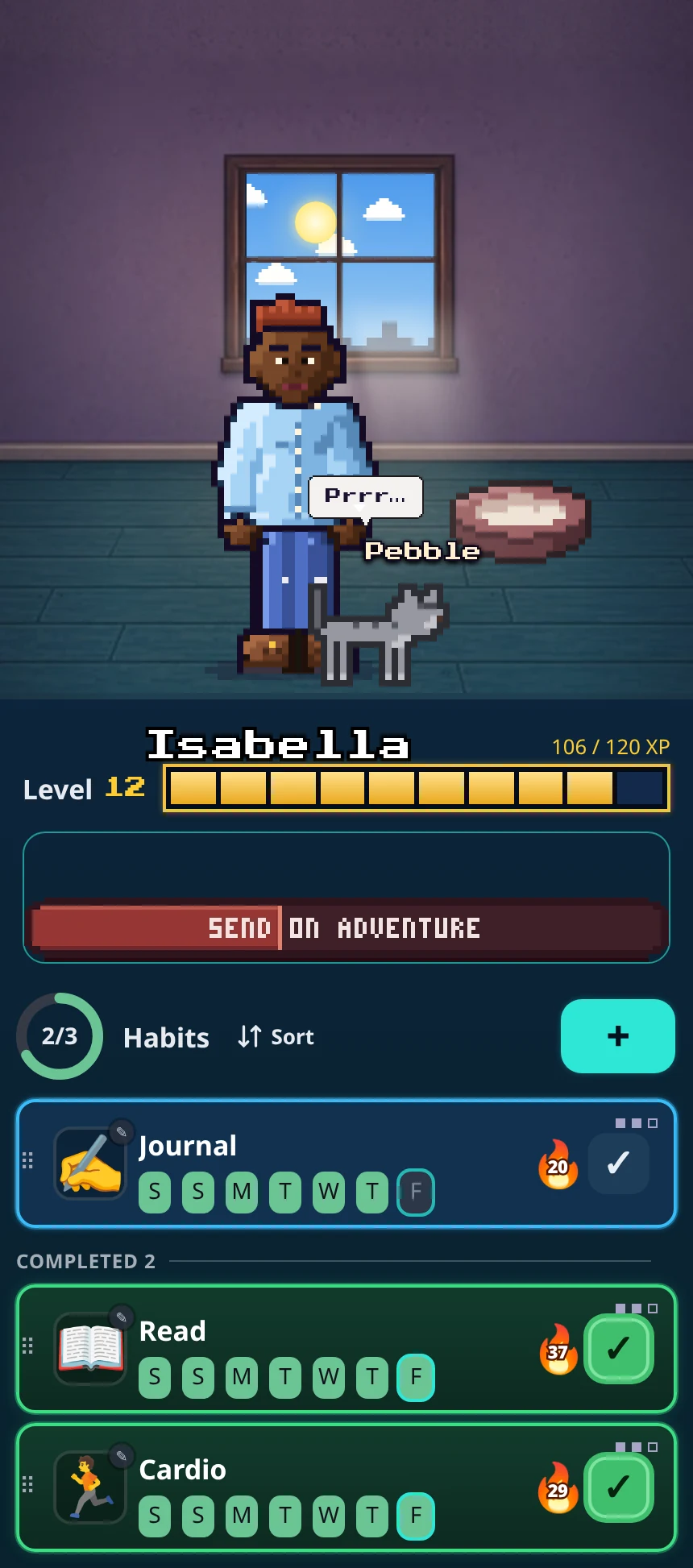
Have you ever played "just one more round" because you were almost at the next level? That pull has a name: the goal gradient. People tend to put in more effort the closer they get to a goal.
Kivetz, Urminsky and Zheng saw this in a café reward program. Customers bought coffee more often as they got closer to earning a free one. A progress bar works the same way. When your bar is almost full, finishing one more habit feels worth it, because you can see exactly what it gets you.
A head start makes you more likely to finish
In a study by Nunes and Drèze, people got loyalty cards for a car wash. Some cards needed 8 stamps. Others needed 10 stamps but came with 2 already filled in. Both needed the same 8 visits. But 34% of the head-start cards were finished, compared with 19% of the blank ones, and people with a head start came back sooner between washes.
The authors call it the endowed progress effect. A task that feels already started is easier to keep going than one that hasn't begun. For habits, that's a good reason to start with something tiny you can check off today. Once your bar has some XP in it, you're not starting from zero anymore.
Can points and levels really change habits?
There's some encouraging evidence. In a randomized trial with 602 adults, Patel and colleagues tested a 24-week game built around step goals, with points and levels. All three game versions helped people walk more each day than a group who only had a wearable tracker.
The study also shows a limit: once the game ended, activity dropped in all groups. The game helped while it was running, which is a good argument for picking a system you'll want to keep using.
Tracking itself matters too. A large review found that monitoring progress helps people reach their goals, especially when progress is recorded (Harkin et al., 2016). XP is one more way to make that record feel rewarding. For a deeper look, see our guide to the gamification of habits.
When XP doesn't help
Game elements aren't a cure-all. A review of empirical studies by Hamari, Koivisto and Sarsa found that gamification generally has positive effects, but those effects depend a lot on the context and on the people using it. Some things to watch for:
- Chasing points instead of the habit. If you start checking off things you didn't really do, the game stops working.
- Too many habits. Twenty habits worth tiny XP each can feel like a second job.
- Feeling bad about the bar. XP should be a nudge, not a judge. A slow week is still progress.
How to set up XP for your real life
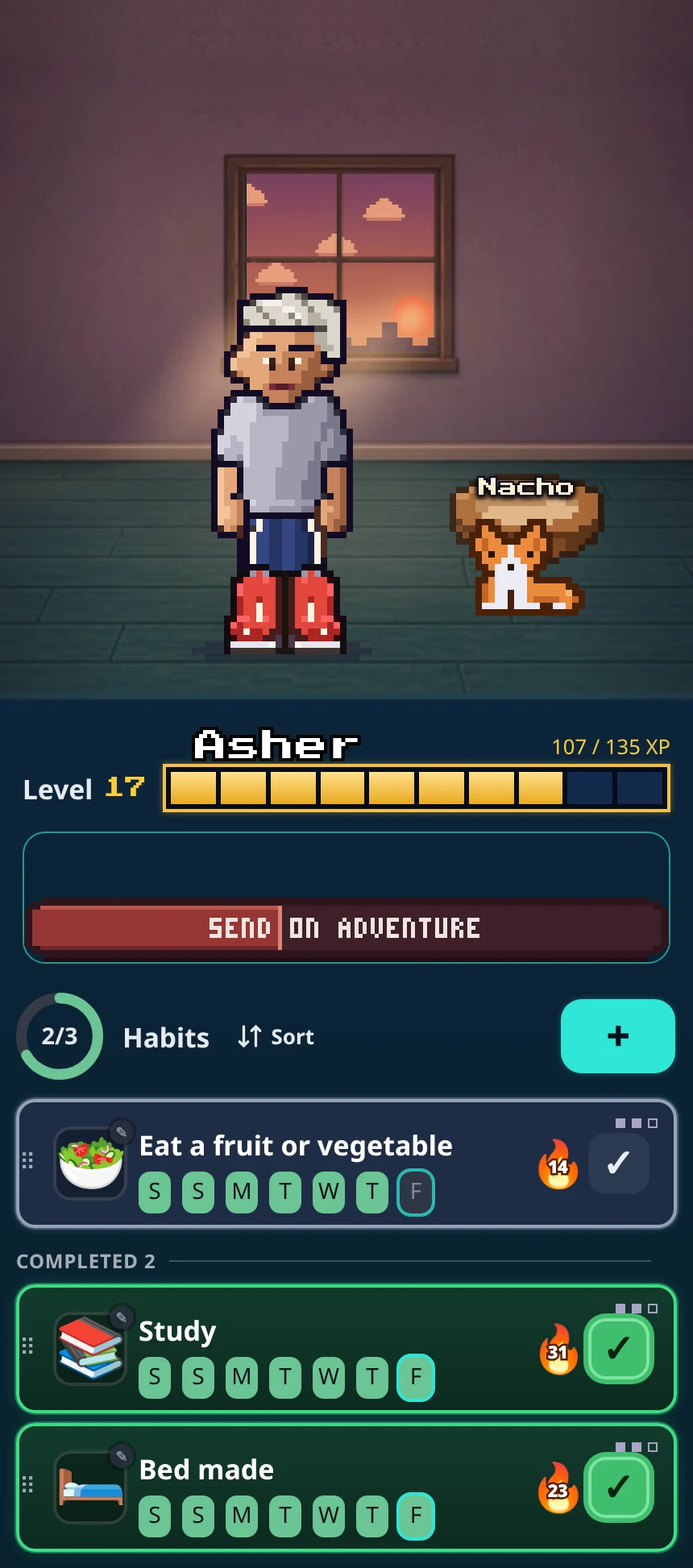
- Pick 3 to 5 habits. Start small enough that you can win today.
- Make "done" clear. "Stretch 5 minutes" is easier to score than "be healthier."
- Get an early win. Add one habit you can check off right now, so your bar already has a head start.
- Watch the bar, not the scoreboard. Compare yourself to last week, not to anyone else.
- Celebrate level-ups. Take a second to notice what got you there.
- Keep it honest. The XP only means something if the habit really happened.
How LevelHabit gives you XP for real life
LevelHabit is a habit tracker built like a small RPG. Every habit you check off earns XP for your pixel hero, and your level bar fills as you go. Fill it up and your hero levels up with a burst of light. Each habit shows its streak flame and a row of the last seven days, and finished habits move into a Completed list so you can see what's left.
Your pet hangs out in your room while the window sky shifts from day to sunset to night. It's a simple loop: do the habit, tap the check, watch your hero grow. That quick, visible reward may help your real-life progress feel as satisfying as a game. Want more on the RPG side? Read our guide to RPG habit trackers.
Key takeaways
- Feeling progress is one of the biggest motivation boosters, and small wins count.
- A nearly full bar pulls you toward finishing.
- A head start makes a goal feel already underway.
- Points and levels can help, but work best when you keep using them.
- Keep XP honest and kind: a nudge, not a judge.
Build your hero, pick your pet, and start earning XP for real life.
Sign up free · Ages 13+
Sources
- Amabile, T. M., & Kramer, S. J. (2011). The power of small wins. Harvard Business Review, 89(5). https://hbr.org/2011/05/the-power-of-small-wins
- Kivetz, R., Urminsky, O., & Zheng, Y. (2006). The goal-gradient hypothesis resurrected: Purchase acceleration, illusionary goal progress, and customer retention. Journal of Marketing Research, 43(1), 39–58. https://doi.org/10.1509/jmkr.43.1.39
- Nunes, J. C., & Drèze, X. (2006). The endowed progress effect: How artificial advancement increases effort. Journal of Consumer Research, 32(4), 504–512. https://doi.org/10.1086/500480
- Patel, M. S., Small, D. S., Harrison, J. D., Fortunato, M. P., Oon, A. L., Rareshide, C. A. L., Reh, G., Szwartz, G., Guszcza, J., Steier, D., Kalra, P., & Hilbert, V. (2019). Effectiveness of behaviorally designed gamification interventions with social incentives for increasing physical activity among overweight and obese adults across the United States: The STEP UP randomized clinical trial. JAMA Internal Medicine, 179(12), 1624–1632. https://doi.org/10.1001/jamainternmed.2019.3505
- Harkin, B., Webb, T. L., Chang, B. P. I., Prestwich, A., Conner, M., Kellar, I., Benn, Y., & Sheeran, P. (2016). Does monitoring goal progress promote goal attainment? A meta-analysis of the experimental evidence. Psychological Bulletin, 142(2), 198–229. https://doi.org/10.1037/bul0000025
- Hamari, J., Koivisto, J., & Sarsa, H. (2014). Does gamification work? A literature review of empirical studies on gamification. Proceedings of the 47th Hawaii International Conference on System Sciences, 3025–3034. https://doi.org/10.1109/HICSS.2014.377
Related: Gamification of habits · RPG habit trackers · Benefits of habit tracking · Habit streaks: motivator or stress trap? · Why pixel art makes progress feel good · How virtual pets can keep you coming back