
How Virtual Pets Can Keep You Coming Back
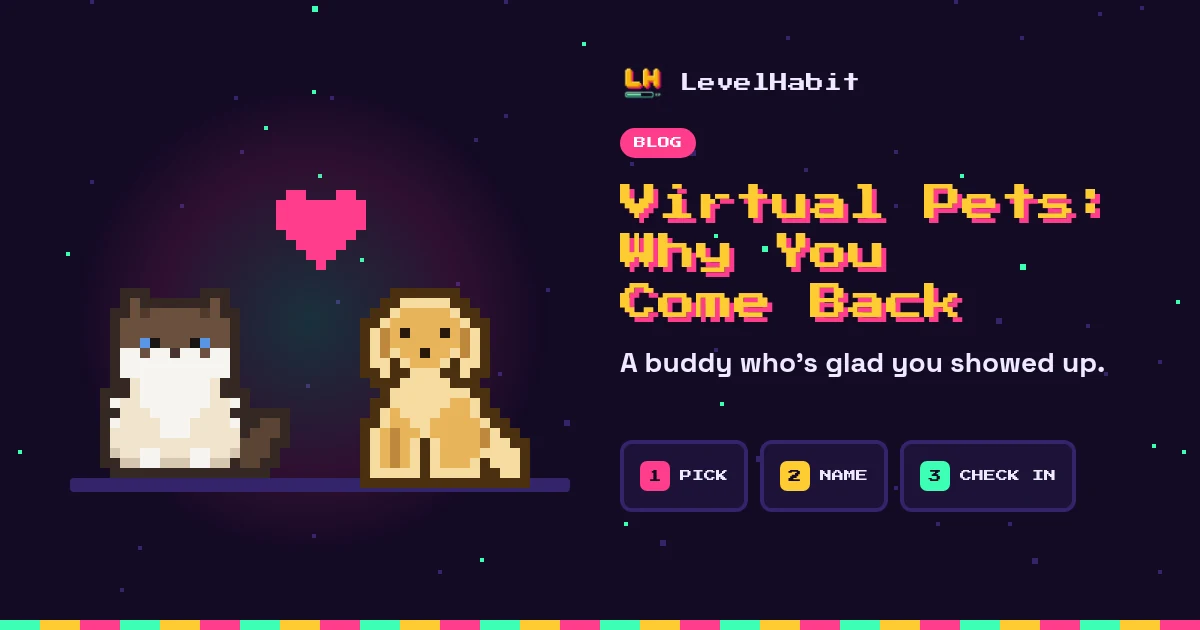
Some days the hardest part of a habit app is opening it. A virtual pet changes that a little. There's someone waiting in your room, with a name you picked, and checking in feels less like homework and more like saying hi.
In this post we look at why a virtual pet in a habit app can make it easier to keep coming back, what research on pet-style and "living" feedback shows, and how to use a pet as a gentle reminder instead of a guilt trip.
The short answer
- Seeing your progress helps. In a three-month study, people whose phone showed a garden that bloomed with their workouts kept their activity steady over the winter holidays. People without the display dropped off (Consolvo et al., 2008).
- A living character gives progress a face. A game that grew a virtual fish from players' step counts helped spark exercise and better attitudes toward activity (Lin et al., 2006).
- Encourage, don't punish. The same research suggests games like this work best when they cheer you on, especially on days you fall short (Lin et al., 2006).
- Game-like features are promising, not magic. A review of 19 studies found mostly positive effects on health behaviors, with mixed results and limited evidence overall (Johnson et al., 2016).
Why a pet makes an app feel alive
A checklist is useful, but it's quiet. Nothing changes if you don't open it. A pet adds a small living thing to the screen. It has a name, it sits in a room, and it's there every time you check in.
That matters because people have a basic need to feel connected. Self-determination theory describes three needs that fuel motivation: competence, autonomy and relatedness, the feeling of being connected to others (Ryan & Deci, 2000). A pixel pet isn't a real friend, but a friendly character can make a routine feel a bit warmer and less like a chore list.
What the research shows
In Fish'n'Steps, each player's daily step count controlled how a virtual fish grew and behaved in a fish tank. Over a 14-week study with 19 people, the game helped get people moving and improved how they felt about physical activity. Interest in the game itself faded after the first couple of weeks, but by then many players had built new routines (Lin et al., 2006).
In UbiFit, a phone's background showed a garden: flowers bloomed as people were active, and butterflies appeared when they hit weekly goals. In a three-month field experiment with 28 people over the winter holidays, those who had the garden display kept up their physical activity. Those without it saw their activity drop significantly (Consolvo et al., 2008).
Neither study used a dog or a cat. They show the same idea, though: a small, glanceable, living picture of your effort can keep a goal on your mind. A broader review of gamified health apps found 59% of studies reported positive effects and 41% mixed effects, and called for more careful research (Johnson et al., 2016). So think of a pet as a helpful nudge, not a cure for low motivation.
Care without guilt
Some virtual pets get sad or sick when you miss a day. That can feel motivating at first and stressful later. The Fish'n'Steps team noted that games like theirs should encourage players rather than punish them, especially when people aren't meeting their own expectations (Lin et al., 2006).
A good pet feature works more like a friend who's happy to see you than a timer counting down. Missing one day also doesn't erase your progress on a habit, which we cover in why missing one day won't break your habit. For more on keeping streaks healthy, see streaks: helpful motivator or stress trap?
How to use a virtual pet to build habits
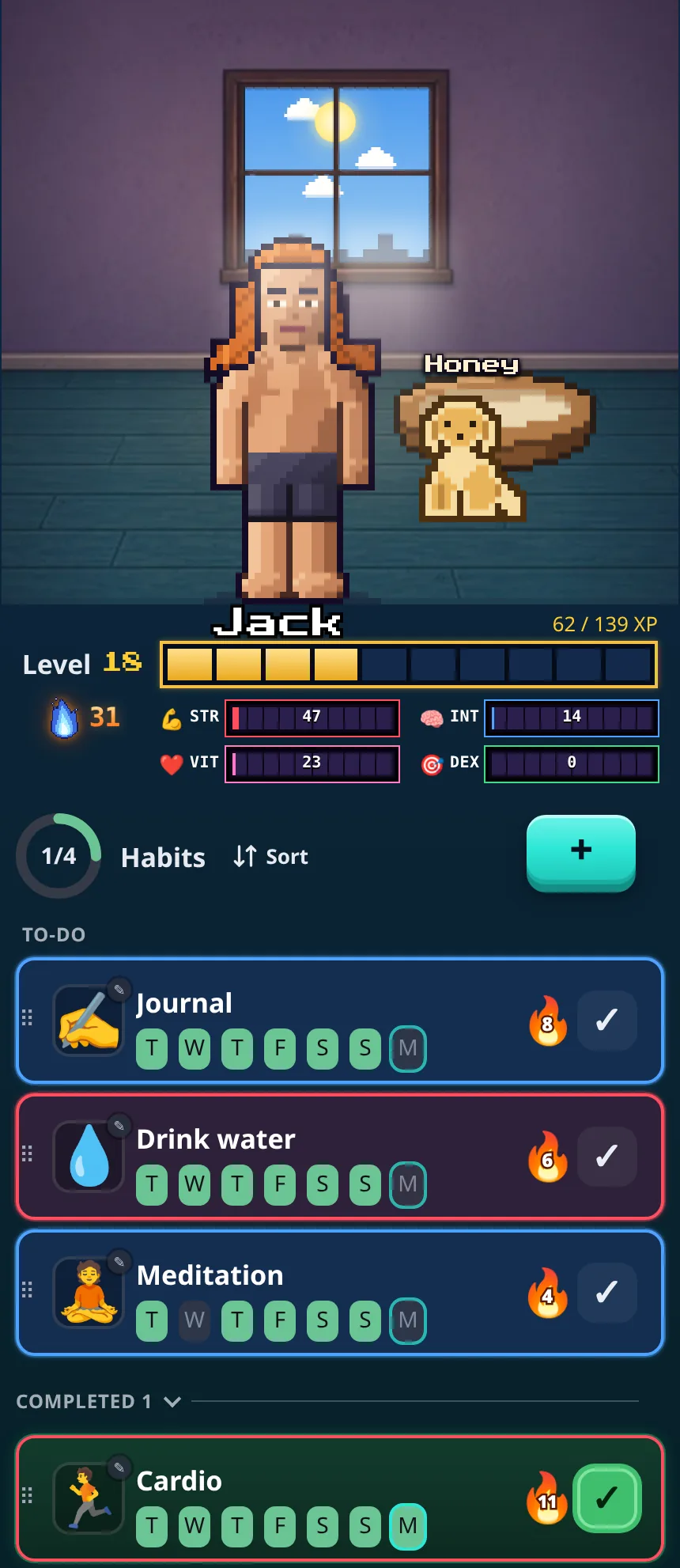
- Give it a name. A name turns "the app" into someone you check on.
- Tie check-ins to a cue. Open the app after something you already do, like pouring coffee or brushing your teeth. That's the same idea as habit stacking.
- Keep the list short. Two or three small habits are easier to keep than ten. If you need ideas, start tiny.
- Let the pet be the hello, not the reason. The pet gets you in the door. The habit is still the win.
- Come back after a miss. Your pet is still there tomorrow. So is your habit.
If you have ADHD, a friendly character you see every time you check in may help keep habits on your radar when out of sight means out of mind. It isn't treatment, but it can make the next check-in feel more inviting. For more ideas, see building habits with ADHD.
How LevelHabit can help
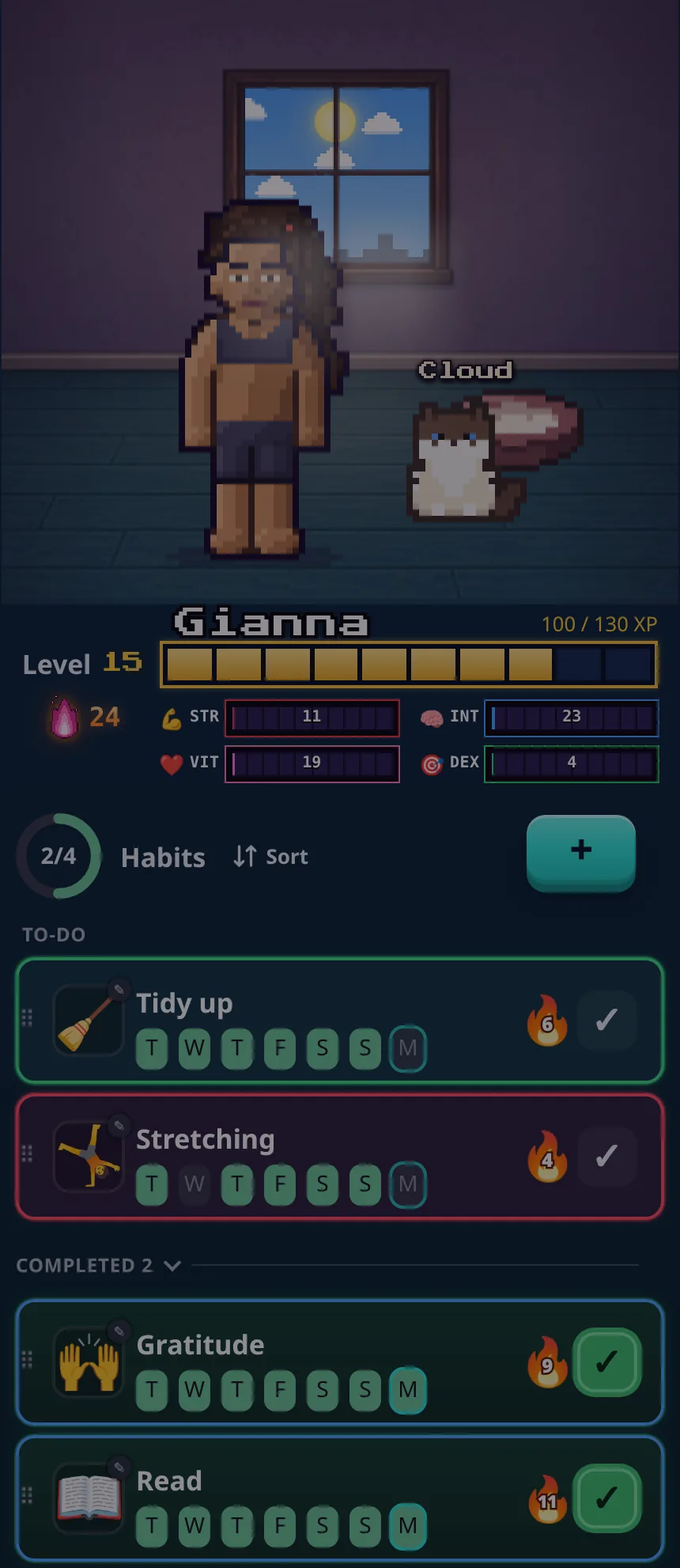
LevelHabit is a pixel-art habit tracker where your habits power a hero and a pet. You can pick from 32 pixel dogs and cats, give your pet a name, and it lives in your room next to your hero, with its own cozy bed. Every habit you check off earns XP and can grow your hero's stats, and your pet is right there when you come back.
Check in when you can, keep the list small, and let your little buddy make the next day a bit easier to start.
Key takeaways
- A pet gives your habits a friendly face and a reason to open the app.
- Research on "living" progress displays, like a growing fish or a blooming garden, suggests they can support activity and awareness.
- Pets work best when they encourage you, not when they punish missed days.
- Use the pet as a cue to check in, and keep the habits themselves small.
This post is for general information and isn't medical advice. If ADHD or daily routines are making life hard, a doctor or mental health professional can help.
Pick your pet, name it, and check in with one small habit today.
Sign up free · Ages 13+
Sources
- Consolvo, S., Klasnja, P., McDonald, D. W., Avrahami, D., Froehlich, J., LeGrand, L., Libby, R., Mosher, K., & Landay, J. A. (2008). Flowers or a robot army? Encouraging awareness & activity with personal, mobile displays. In Proceedings of the 10th International Conference on Ubiquitous Computing (UbiComp '08) (pp. 54–63). ACM. https://doi.org/10.1145/1409635.1409644
- Lin, J. J., Mamykina, L., Lindtner, S., Delajoux, G., & Strub, H. B. (2006). Fish'n'Steps: Encouraging physical activity with an interactive computer game. In UbiComp 2006: Ubiquitous Computing (Lecture Notes in Computer Science, Vol. 4206, pp. 261–278). Springer. https://doi.org/10.1007/11853565_16
- Johnson, D., Deterding, S., Kuhn, K.-A., Staneva, A., Stoyanov, S., & Hides, L. (2016). Gamification for health and wellbeing: A systematic review of the literature. Internet Interventions, 6, 89–106. https://doi.org/10.1016/j.invent.2016.10.002
- Ryan, R. M., & Deci, E. L. (2000). Self-determination theory and the facilitation of intrinsic motivation, social development, and well-being. American Psychologist, 55(1), 68–78. https://doi.org/10.1037/0003-066X.55.1.68
Related: XP for real life · Why pixel art feels good · Gamification of habits