
Habit Streaks: Helpful Motivator or Stress Trap?

A streak is a simple thing: a number that goes up every day you show up. Seven days of reading. Thirty days of stretching. That little flame can be the reason you get off the couch at 10 PM to do your habit. It can also be the reason one missed day makes you want to quit altogether.
So are habit streaks a helpful motivator or a stress trap? Research says they can be both. Here's what studies show about why streaks pull you in, when they backfire, and how to set yours up so they keep you going without the pressure.
The short answer
- Streaks can boost motivation. Across seven studies, people did a behavior more when their log showed an intact streak than when it showed a broken one (Silverman & Barasch, 2023).
- A broken streak can drag you down. In the same research, the drop was bigger when people blamed themselves for the break, and smaller when the streak could be repaired.
- Tracking can feel like work. Measuring an activity made people do more of it but enjoy it less (Etkin, 2016).
- Coming back matters. In a study of 61,293 gym members, the top program gave a small reward for returning after a missed workout (Milkman et al., 2021).
- A little slack helps. Goals with a built-in "emergency reserve" were preferred and led to more persistence (Sharif & Shu, 2017).
Why habit streaks work

Two consumer researchers studied streaks, which they define as doing a behavior three or more times in a row. In seven studies, people were more likely to keep going when their log highlighted an intact streak than when it highlighted a broken one.
The interesting part: this happened even when people's actual past behavior was the same. What changed was how that behavior was shown in the log. The researchers found that people treat keeping a streak alive as a meaningful goal in its own right. The number isn't just a record of what you did. It becomes something you want to protect.
That's why a streak can be such a good nudge on low-energy days. You might not feel like reading tonight, but you might not want to see 20 days go back to zero either.
When a streak becomes a stress trap
The same thing that makes a streak motivating can make it stressful. If the streak is the goal, then breaking it can feel like failing, even if you've done the habit most days for months.
The streak researchers found that the drop-off after a broken streak was stronger when people blamed themselves for the break than when they saw an outside cause. It was weaker when people could repair the streak. In other words, it's not the missed day that hurts most. It's the story you tell yourself about it.
There's another risk. In six experiments, a consumer researcher found that measuring an activity, like counting steps or pages, made people do more of it but enjoy it less. Measurement drew attention to output and made fun activities feel more like work, which lowered people's interest in continuing. Streaks are a kind of measurement, so it's worth keeping an eye on how yours makes you feel.
Some signs your streak has turned into a stress trap:
- You do the habit just to save the number, not because it helps you.
- You dread checking your tracker on busy days.
- One miss makes you want to give up on the whole habit.
- You'd rather check it off than actually do it.
The comeback beats the record
If a broken streak is where people tend to quit, then the most useful skill is getting back on track fast. A huge field experiment backs this up. A team of behavioral scientists tested 54 different four-week programs with 61,293 members of a US gym chain. The best performer gave members a small bonus for returning to the gym after a missed workout. It increased weekly gym visits by an estimated 27% compared with a placebo group. (The authors note that the top results in a study like this are probably a bit inflated, but it still stood out.)
Missing a day also doesn't seem to undo your progress. In a study of how habits form in everyday life, missing one chance to do the behavior did not materially affect the habit-forming process (Lally et al., 2010). We cover that in more detail in why missing one day won't break your habit.
So when your streak resets, treat the next check-in as the win. A streak of 1 is the start of the next one.
Build slack into your streaks

A streak that demands perfection every single day is fragile. Two marketing researchers studied a different kind of goal: a hard goal with an emergency reserve, meaning a set amount of slack you can use if you really need it, at a small cost. One example they give is an emergency skip day for the gym.
Across six studies, people preferred goals with an emergency reserve over goals without one. They also persisted more, partly because they tried not to use up their reserve. A little planned flexibility made the goal feel more doable without making people slack off.
You can build the same kind of slack into your habit streaks:
- Only schedule the days you mean. If you work out three days a week, track it on those three days instead of all seven. A rest day isn't a miss.
- Use a weekly target for flexible habits. "Creative time 3 times a week" gives you room to move sessions around.
- Make the minimum tiny. On a rough day, two minutes of stretching still counts.
- Decide your plan for a missed day ahead of time. For example: "If I miss, I do it first thing tomorrow."
How to use streaks without the stress
- Let the streak be a nudge, not the goal. The habit is the point. The number is just a reminder.
- Watch the bigger picture. 25 out of 30 days is a strong month, even if your current streak says 3.
- Be kind about breaks. Since self-blame makes broken streaks hurt more, try "life happened" instead of "I failed."
- Pick habits that fit your real week. Daily habits for daily things, weekly targets for the rest.
- Celebrate the restart. Getting back on track after a miss is the skill that keeps habits going.
How streaks work in LevelHabit
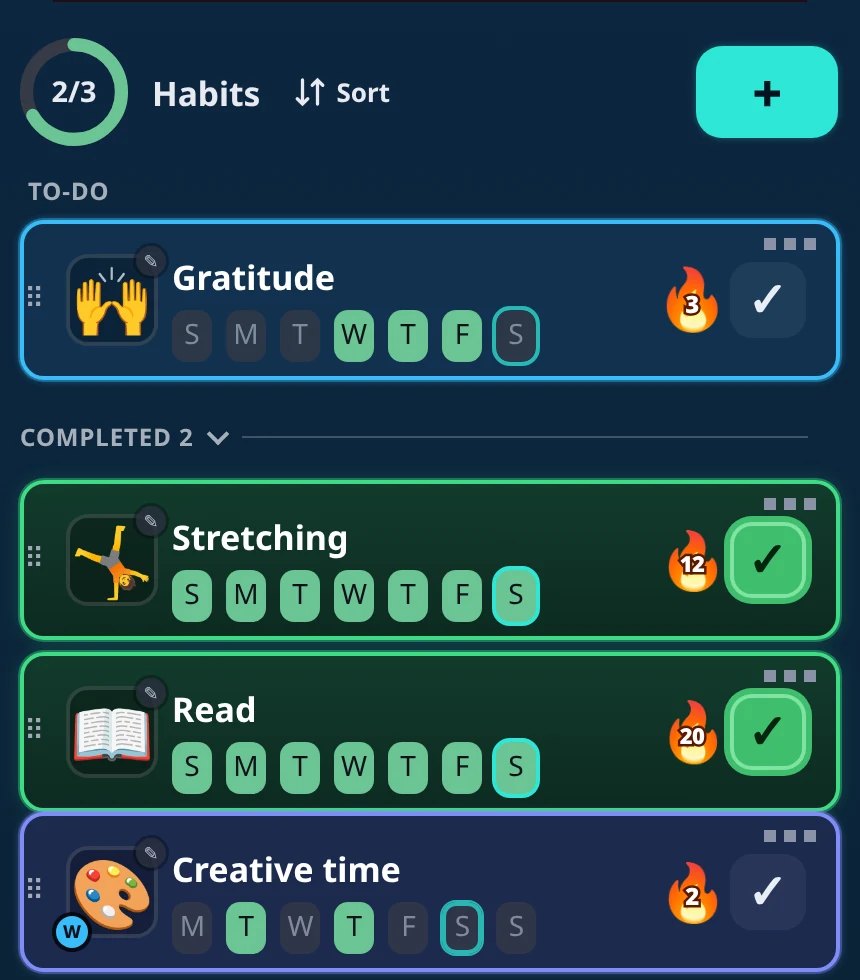
LevelHabit is a habit tracker built like a small RPG. Each habit shows a streak flame with its current count, next to a row of days so you can see your week at a glance. Every habit you check off also earns XP for your pixel hero, so your level bar keeps filling even on a day you're starting a streak over.
You can set a habit to only the days you plan to do it, like Monday, Wednesday and Friday, so the other days don't count against you. For flexible habits, weekly and monthly habits (marked W or M) let you aim for a number of times instead of every day. It's a simple way to keep the motivation of a streak while leaving room for real life. Want more on the game side? Read our guide to XP for real life.
Key takeaways
- Seeing an intact streak can make you more likely to keep going.
- Broken streaks hurt most when you blame yourself, so be kind about misses.
- Tracking can make habits feel like work. Keep the habit, not the number, as the goal.
- Coming back after a miss matters more than a perfect record.
- Build in slack with set days and weekly targets so your streak fits your life.
Build your hero, pick your pet, and start a streak that works with your week.
Sign up free · Ages 13+
Sources
- Silverman, J., & Barasch, A. (2023). On or off track: How (broken) streaks affect consumer decisions. Journal of Consumer Research, 49(6), 1095–1117. https://doi.org/10.1093/jcr/ucac029
- Etkin, J. (2016). The hidden cost of personal quantification. Journal of Consumer Research, 42(6), 967–984. https://doi.org/10.1093/jcr/ucv095
- Milkman, K. L., Gromet, D., Ho, H., et al. (2021). Megastudies improve the impact of applied behavioural science. Nature, 600, 478–483. https://doi.org/10.1038/s41586-021-04128-4
- Lally, P., van Jaarsveld, C. H. M., Potts, H. W. W., & Wardle, J. (2010). How are habits formed: Modelling habit formation in the real world. European Journal of Social Psychology, 40(6), 998–1009. https://doi.org/10.1002/ejsp.674
- Sharif, M. A., & Shu, S. B. (2017). The benefits of emergency reserves: Greater preference and persistence for goals that have slack with a cost. Journal of Marketing Research, 54(3), 495–509. https://doi.org/10.1509/jmr.15.0231
Related: Why missing one day won't break your habit · Benefits of habit tracking · XP for real life