
ADHD Cleaning Routine: A Room-by-Room Plan

You walk into the kitchen to wipe the counter, notice the mail, start sorting it, find a sock, carry it to the bedroom, and twenty minutes later the counter is still sticky. If cleaning feels like that, you're not lazy. You might just be trying to clean the whole house at once.
A good ADHD cleaning routine shrinks the job. Instead of one huge "clean everything" day, you give each room its own small slot in the week and keep a couple of tiny daily resets. Here's why that may help, what research says about clutter and planning, and a room-by-room plan you can copy.
The short answer
- ADHD can make chores harder. Trouble staying organized and keeping on task are core parts of ADHD, and symptoms can show up at home as well as at school or work (NIMH).
- A messy home can weigh on you. Women who described their homes as cluttered and unfinished had less healthy daily stress-hormone patterns and more low mood as the day went on (Saxbe & Repetti, 2010).
- If-then plans help people follow through. A review of 94 tests found that plans like "When X happens, I'll do Y" had a medium-to-large effect on reaching goals (Gollwitzer & Sheeran, 2006).
- Those plans may help with ADHD too. In a lab task, children with ADHD who made if-then plans held back an unwanted response as well as children without ADHD (Gawrilow & Gollwitzer, 2008).
- Small and regular beats big and rare. One room a day for 10 to 15 minutes, plus a quick daily reset, is easier to start than a weekend marathon.
Why cleaning is extra hard with ADHD
Cleaning looks simple, but it's really a long chain of small decisions. Where does this go? What do I do first? Is this trash? Each choice pulls on the same skills ADHD can make harder: getting started, staying on one task, and keeping track of what's done.
The National Institute of Mental Health describes inattention in ADHD as having difficulty paying attention, keeping on task, or staying organized. For people with ADHD, those behaviors are frequent and show up across settings, including at home. So when a room turns into a maze of side quests, that's a pretty normal ADHD experience, not a character flaw.
The fix isn't more willpower. It's a routine that makes fewer decisions for you: which room, how long, and what "done" looks like.
Why a tidier space is worth a little effort
In one study, researchers recorded 60 working spouses giving self-guided tours of their homes, then counted the words they used. Wives whose tours had more talk of clutter and unfinished projects had flatter daily cortisol patterns, a stress-hormone profile linked with poorer health. They also had more depressed mood over the day. Wives who described their homes as restful showed the opposite.
A separate survey of adults in the US and Canada found that clutter had a negative link with people's sense of "home" and with their overall well-being (Roster, Ferrari & Jurkat, 2016). Both studies show links, not proof that cleaning fixes mood. Still, they back up what a lot of people feel: walking into a calmer room can make the rest of the day a little easier.
You don't need a magazine home for that. A clear counter and a made bed can be enough to change how a room feels.
The room-by-room ADHD cleaning routine
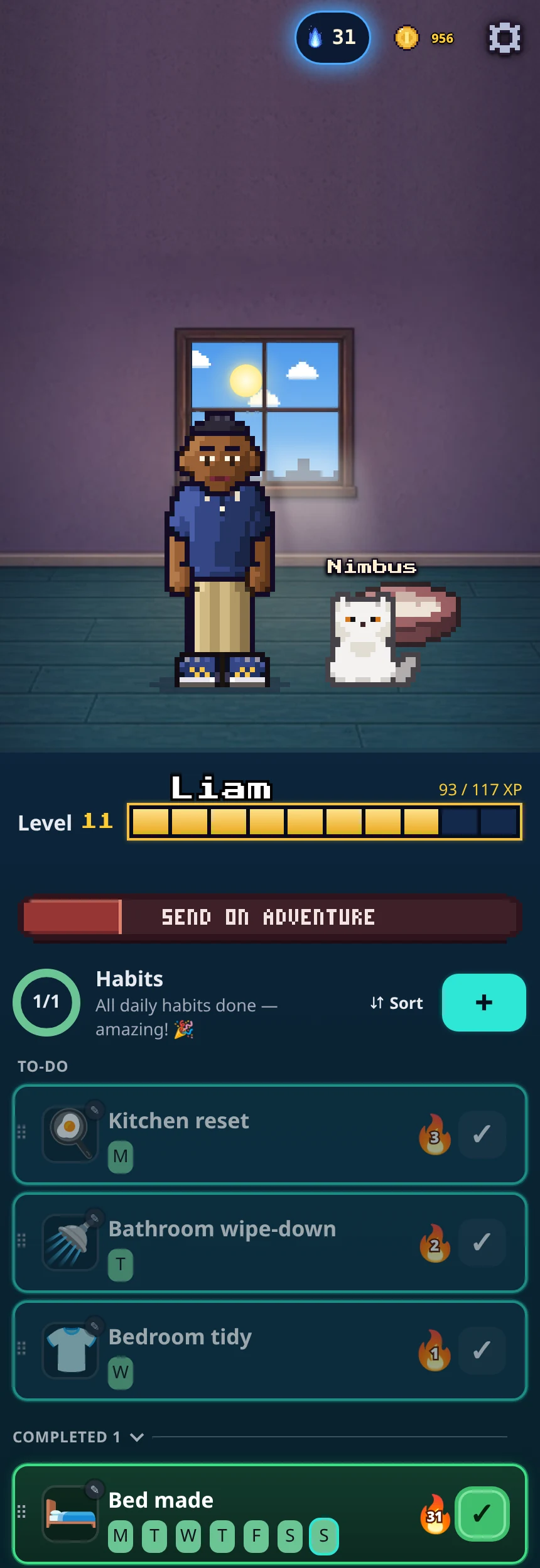
Here's the core idea: one room per day, 10 to 15 minutes, then stop. Stopping on time matters. It keeps the job small enough to start tomorrow too. Swap the days around to fit your week.
- Monday: kitchen. Wipe the counters and stovetop, clear out old food from the fridge, and take out the trash.
- Tuesday: bathroom. Wipe the sink and mirror, swap the towels, and give the toilet a quick clean.
- Wednesday: bedroom. Clothes in the hamper or the closet, clear the nightstand, and put away anything that wandered in.
- Thursday: living room. Return stray items to their rooms, fold the blankets, and clear the coffee table.
- Friday: entryway and desk. Shoes, bags and mail. Toss the junk mail and put anything you need to deal with in one spot.
- Weekend: one bigger job. Laundry, vacuuming or floors. Pick one, not all three.
Every day, add two tiny resets that take a few minutes each: make your bed and do the dishes. They're the habits that make the whole home look better fastest, and they give you an easy early win.
Make each room easy to start
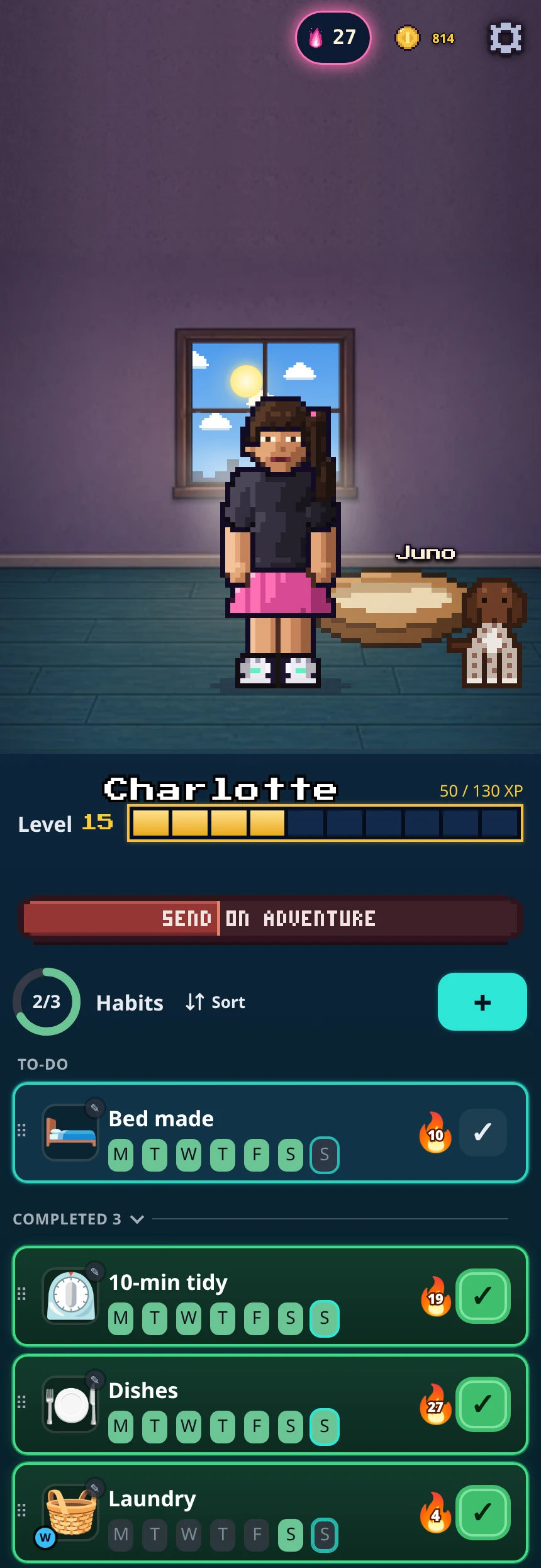
Getting started is often the hardest part. These tricks lower the bar:
- Use an if-then cue. Tie each room to something that already happens. "When I finish my morning coffee, I wipe the kitchen counters." "When I get home on Friday, I clear the entryway." That's an if-then plan, the kind of plan that research links to better follow-through.
- Set a timer. Ten minutes has a clear end, which makes it easier to begin. When it rings, you're allowed to stop.
- Start with trash. Grab a bag and toss what's obviously garbage. It needs almost no decisions and shows quick progress.
- Use a "not sure" basket. Anything you can't decide on goes in one basket for later, so one item doesn't stall the whole room.
- Keep supplies where you use them. A spray bottle and a cloth under the bathroom sink beat a trip across the house.
- Pair it with something fun. A playlist or podcast that you only play while cleaning can make the time go faster.
When you fall behind
Some weeks, every room gets messy at once. That's okay. Don't try to catch up on everything in one go. Just do today's room, plus the dishes. A missed day doesn't erase your progress. In a study of how habits form, missing one chance to do a habit did not really affect the habit-building process (Lally et al., 2010). We dig into that in why missing one day won't break your habit.
If even ten minutes feels like too much, shrink it to two. Wipe one counter. Put away five things. A tiny version still keeps the routine alive.
Track it like a game in LevelHabit
LevelHabit is a habit tracker built like a small RPG, and its ready-made habits include chores like Bed made, Dishes, Laundry, Vacuum and Mop floors. You can set each room habit to only the day it belongs to, like Tuesday for the bathroom, so the other days don't count against it. Bigger jobs like laundry or vacuuming can be weekly habits, so you can fit them in on any day that week.
Every check-in earns XP for your pixel hero, and your pet hangs out with you in your room. That quick bit of feedback may help on days when a clean counter alone doesn't feel like enough of a reward. For more on why that works, read about ADHD and rewards.
Key takeaways
- ADHD can make it harder to stay organized and on task, so cleaning everything at once is a tough ask.
- Clutter is linked with more stress and lower well-being, so small tidy-ups can be worth it.
- Give each room one day and 10 to 15 minutes, then stop.
- Keep two tiny daily resets: make the bed and do the dishes.
- Use if-then cues and timers to make starting easier, and shrink the task on hard days.
Build your hero, pick your pet, and turn your cleaning routine into quests you can actually finish.
Sign up free · Ages 13+
Sources
- National Institute of Mental Health. Attention-Deficit/Hyperactivity Disorder (ADHD). https://www.nimh.nih.gov/health/topics/attention-deficit-hyperactivity-disorder-adhd
- Saxbe, D. E., & Repetti, R. (2010). No place like home: Home tours correlate with daily patterns of mood and cortisol. Personality and Social Psychology Bulletin, 36(1), 71–81. https://doi.org/10.1177/0146167209352864
- Roster, C. A., Ferrari, J. R., & Jurkat, M. P. (2016). The dark side of home: Assessing possession 'clutter' on subjective well-being. Journal of Environmental Psychology, 46, 32–41. https://doi.org/10.1016/j.jenvp.2016.03.003
- Gollwitzer, P. M., & Sheeran, P. (2006). Implementation intentions and goal achievement: A meta-analysis of effects and processes. Advances in Experimental Social Psychology, 38, 69–119. https://doi.org/10.1016/S0065-2601(06)38002-1
- Gawrilow, C., & Gollwitzer, P. M. (2008). Implementation intentions facilitate response inhibition in children with ADHD. Cognitive Therapy and Research, 32(2), 261–280. https://doi.org/10.1007/s10608-007-9150-1
- Lally, P., van Jaarsveld, C. H. M., Potts, H. W. W., & Wardle, J. (2010). How are habits formed: Modelling habit formation in the real world. European Journal of Social Psychology, 40(6), 998–1009. https://doi.org/10.1002/ejsp.674
Related: ADHD morning routine · ADHD and rewards · Habit stacking