
ADHD and Rewards: Why Instant Feedback Can Help
If you have ADHD, you may have noticed something odd about motivation. A reward that comes right away can get you moving, while a bigger reward that's weeks away barely registers. That's not a lack of willpower. Researchers have studied this pattern for decades, and it has a lot to do with timing.
Here's what the research says about ADHD and rewards, why instant feedback can matter so much, and how to use quick wins to build habits that last.
The short answer
- Delays hit harder with ADHD. Studies find that people with ADHD tend to discount delayed rewards more steeply and often prefer smaller rewards that come sooner.
- Rewards still work. Rewards improve performance and motivation for kids with and without ADHD, and the effect on performance may be a bit stronger with ADHD.
- Instant feedback closes the gap. A small reward right after a habit gives your brain something now, instead of a payoff months away.
- It isn't a cure. Quick rewards may help with habits, but they don't treat ADHD.
Why delayed rewards feel so far away
Most good habits pay off slowly. A walk today won't change your fitness by tonight, and one study session won't change your grades this week. The real reward is real, but it's delayed.
Psychologists call the drop in value over time delay discounting. Everyone does it a little: a small treat today often feels better than a bigger one next month. A meta-analysis pooled 25 comparisons from 21 studies with 3,913 people and found that people with ADHD discounted delayed money more steeply than people without ADHD, with a medium-sized difference. The gap showed up in both children and adults (Jackson & MacKillop, 2016).
An early study gave hyperactive and non-hyperactive kids repeated choices between a small reward now and a bigger reward later. The hyperactive kids were more likely to pick the small, quick reward when it shortened the overall wait. The researchers suggested the key driver was avoiding the delay itself, an idea now known as delay aversion (Sonuga-Barke et al., 1992).
What research says about ADHD and rewards
Rewards help, and timing matters. A review of 22 studies with 1,181 children looked at how rewards and penalties affect kids with ADHD. Rewards improved task performance and motivation for children with and without ADHD, and the boost to performance was somewhat larger for kids with ADHD. Children with ADHD also preferred immediate rewards over delayed ones, and there was some evidence that strong, frequent rewards worked especially well (Luman et al., 2005).
One theory points to how the brain predicts rewards. Normally, the brain's dopamine response gradually shifts from the reward itself to the cues that come before it, which helps bridge the wait. The dopamine transfer deficit theory proposes that this anticipatory response is weaker in ADHD, so rewards that are far away may feel less motivating. It's a theory, not a settled fact, but it fits the pattern above (Tripp & Wickens, 2008).
Reward-based support is well studied for kids. Behavioral approaches such as parent training and classroom management, which typically rely on clear goals, consistent feedback and structured rewards, are considered well-established treatments for children with ADHD (Pelham & Fabiano, 2008).
A fair caveat: much of this research is with children. The delay discounting meta-analysis didn't find a difference between younger and older samples, but there's less direct research on reward systems for adults.
Why instant rewards help everyone stick with goals
This isn't only an ADHD thing. In a set of studies, people pursuing goals like New Year's resolutions, studying and exercise kept going longer when the activity had an immediate reward, such as enjoyment. Delayed rewards, like better health later, predicted persistence much less, even though people said those were their main reasons (Woolley & Fishbach, 2017).
So if you have ADHD, the takeaway isn't "you're broken." It's that a tendency most people share may be stronger for you, which makes building in a reward right now even more useful.
How to use instant rewards for your habits
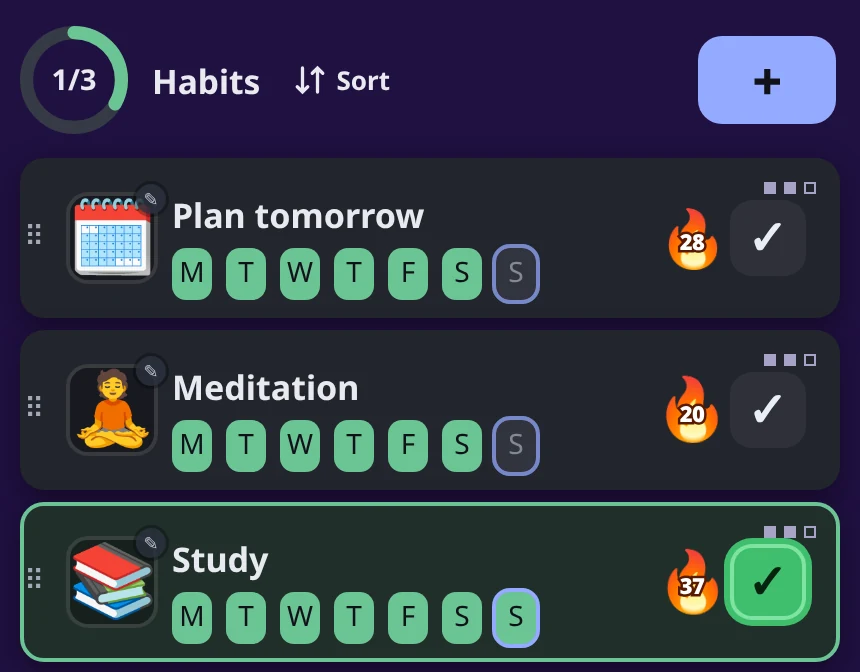
- Reward the action, right away. The closer the reward is to the habit, the better. A check mark, a point or a little sound in the same minute beats a treat at the end of the month.
- Make the reward visible. A filling progress bar or a row of checked days turns a slow payoff into something you can see today.
- Keep habits tiny. "Put on running shoes" is easier to start than "run 5K." Small steps mean more frequent wins.
- Stack small wins into bigger ones. Let daily points add up to a weekly goal, so short-term and long-term rewards work together.
- Pair dull tasks with something fun. Music while you tidy or a favorite drink while you study adds an immediate payoff to a task that doesn't have one.
- Change things up. If a reward stops feeling exciting, swap it for a new one. Novelty can help keep motivation going.
- Be kind about misses. A reward system should feel encouraging. Missing one day won't break your habit.
Common reward mistakes
- Rewards that come too late. "I'll buy myself something if I exercise for three months" is a long wait for a brain that likes things now.
- Rewards that undo the habit. A big dessert after every workout can work against your goal. Choose rewards that fit what you're building.
- All or nothing. If the only reward is for a perfect week, one slip can wipe out the motivation. Reward each step.
- Too many habits at once. Spreading rewards across ten new habits makes each win feel small. Start with two or three.
How LevelHabit gives you instant feedback
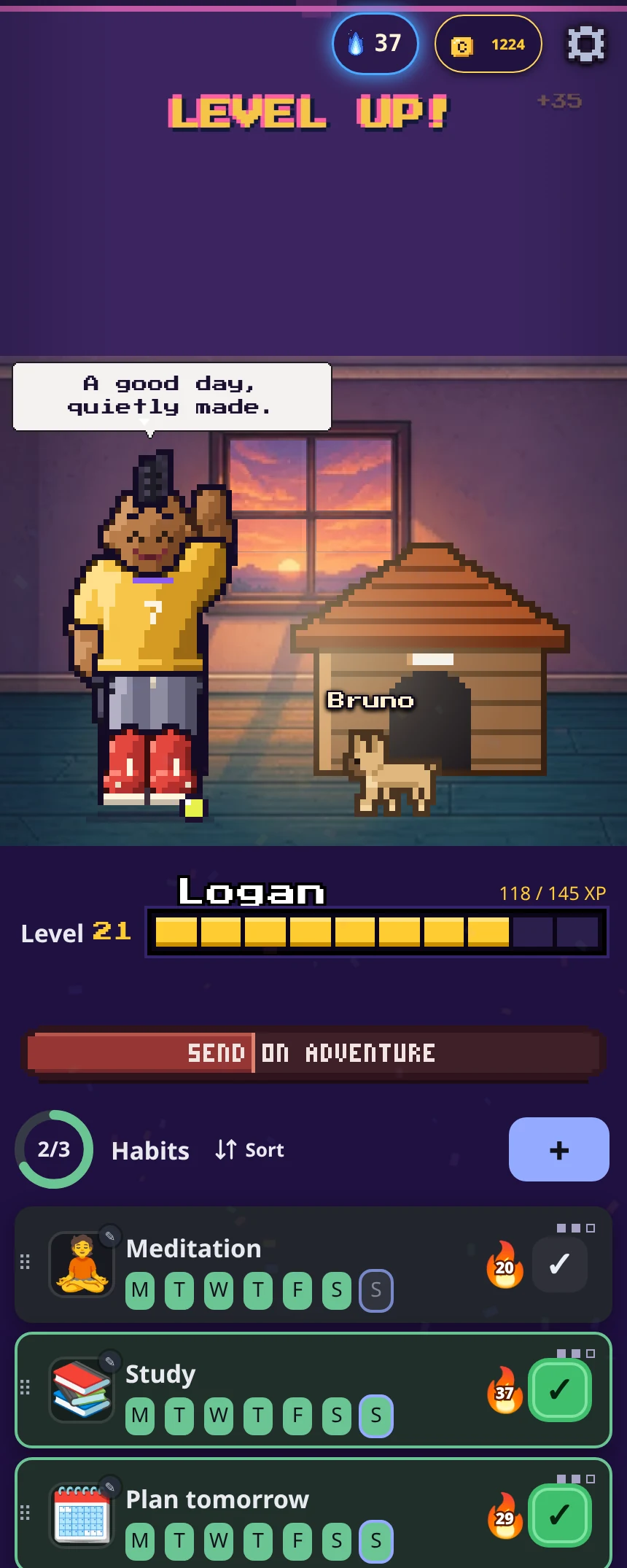
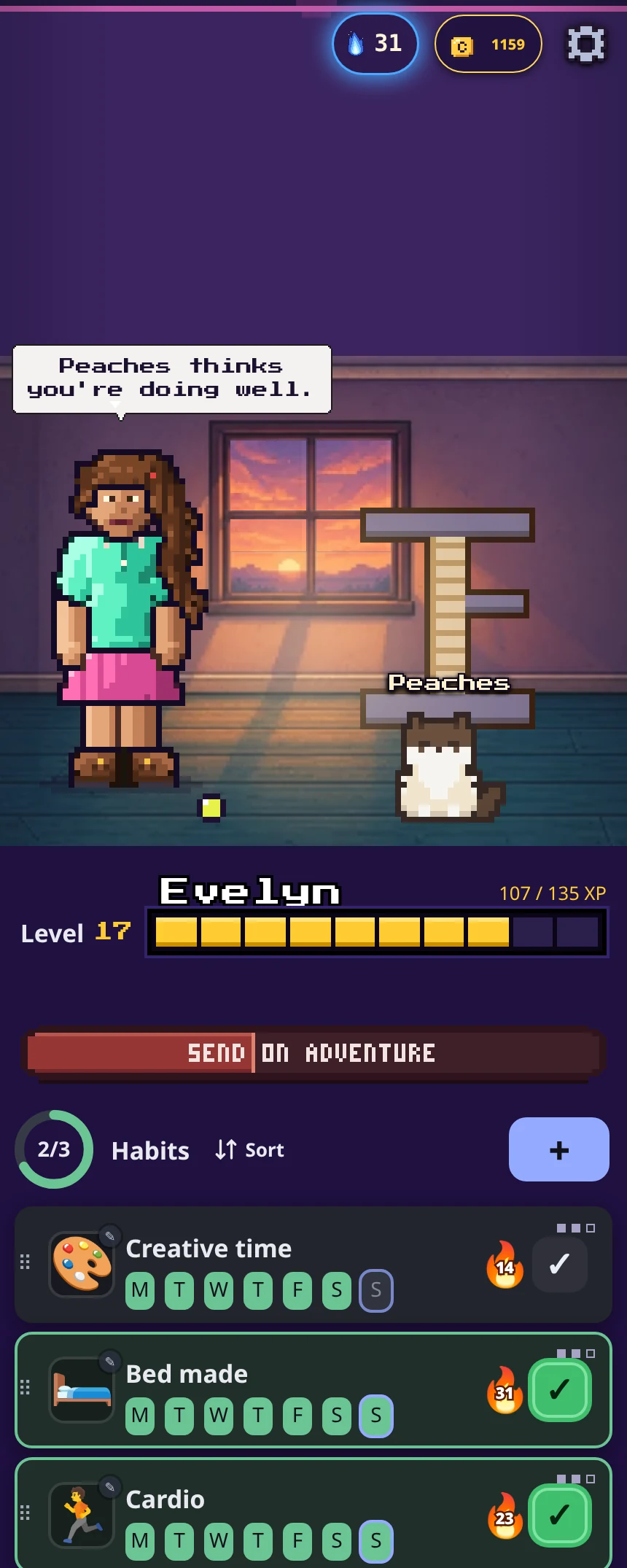
LevelHabit is a pixel-art gamified habit tracker built around quick wins. Checking off a habit takes one tap and earns XP right away, which fills your hero's level bar while you watch. A daily quest gives you a small goal for today, and your pet keeps you company in your room.
You create your own hero, keep your list short, and see each habit's week at a glance with day pills and a streak count. Long-term goals still matter, but every check-in also gives you something right now.
If you have ADHD, instant feedback like this may help you stay motivated with daily habits. It isn't a treatment, though. If you think you might have ADHD, talk to a doctor or a qualified professional. You can also read our guide on choosing a habit tracker for ADHD.
Key takeaways
- People with ADHD tend to discount delayed rewards more steeply and often prefer quicker ones.
- Rewards improve motivation and performance, and timing matters a lot.
- Even outside ADHD, immediate rewards predict sticking with goals better than delayed ones.
- Reward the action right away, make progress visible, and keep habits small.
- Instant rewards may help with habits, but they aren't a treatment for ADHD.
FAQ
Why do people with ADHD prefer instant rewards?
Research finds that people with ADHD tend to value delayed rewards less and may find waiting itself unpleasant. One theory suggests the brain's response to cues that predict a reward is weaker, so far-off rewards feel less motivating.
Do reward systems work for adults with ADHD?
Many adults find them useful, and the pattern of preferring sooner rewards shows up in adults too. Most studies of structured reward programs have focused on children, so results for adults are less certain and vary from person to person.
What are good instant rewards for habits?
Quick, small and immediate works best: checking a box, earning points, a short break, a favorite song or watching a progress bar fill. Pick rewards that support your goal instead of undoing it.
Can a habit tracker app help with ADHD?
A tracker that gives instant feedback and shows your progress may help you stay on track with daily habits. It works best alongside any care plan you have with a professional.
Get your first quick win
Build your hero, pick your pet, and earn XP the moment you check off a habit.
Sign up free · Ages 13+
Sources
- Jackson, J. N., & MacKillop, J. (2016). Attention-deficit/hyperactivity disorder and monetary delay discounting: A meta-analysis of case-control studies. Biological Psychiatry: Cognitive Neuroscience and Neuroimaging, 1(4), 316–325. https://doi.org/10.1016/j.bpsc.2016.01.007
- Sonuga-Barke, E. J. S., Taylor, E., Sembi, S., & Smith, J. (1992). Hyperactivity and delay aversion, I: The effect of delay on choice. Journal of Child Psychology and Psychiatry, 33(2), 387–398. https://doi.org/10.1111/j.1469-7610.1992.tb00874.x
- Luman, M., Oosterlaan, J., & Sergeant, J. A. (2005). The impact of reinforcement contingencies on AD/HD: A review and theoretical appraisal. Clinical Psychology Review, 25(2), 183–213. https://doi.org/10.1016/j.cpr.2004.11.001
- Tripp, G., & Wickens, J. R. (2008). Research review: Dopamine transfer deficit: A neurobiological theory of altered reinforcement mechanisms in ADHD. Journal of Child Psychology and Psychiatry, 49(7), 691–704. https://doi.org/10.1111/j.1469-7610.2007.01851.x
- Pelham, W. E., Jr., & Fabiano, G. A. (2008). Evidence-based psychosocial treatments for attention-deficit/hyperactivity disorder. Journal of Clinical Child & Adolescent Psychology, 37(1), 184–214. https://doi.org/10.1080/15374410701818681
- Woolley, K., & Fishbach, A. (2017). Immediate rewards predict adherence to long-term goals. Personality and Social Psychology Bulletin, 43(2), 151–162. https://doi.org/10.1177/0146167216676480
Related: Habit tracker for ADHD · What is gamification? · The science of self-monitoring · ADHD morning routine: 5 steps you can keep · The habit loop: cue, routine, reward · Time blindness and daily habits