
An ADHD Morning Routine You Can Actually Keep
Mornings can be the hardest part of the day with ADHD. There are lots of small steps, a clock that keeps moving, and no one there to say what comes next. A good ADHD morning routine isn't a long checklist. It's a short, fixed order of a few easy steps you can see, check off and repeat.
Here's why mornings can feel so hard, what research says may help, and how to build a routine you can actually keep.
The short answer
- Keep it short. Start with three steps, not ten. A routine you finish beats a perfect one you drop.
- Use if-then plans. In one study, children with ADHD who used simple "if X, then Y" plans did better on a task that needed them to stop and switch, compared with children who only set a goal (Gawrilow & Gollwitzer, 2008).
- Make it visible. Seeing each step, and checking it off, may help you keep your place when your attention drifts.
- Be patient. In one real-world study, new daily habits took a median of 66 days to feel automatic, and missing a single day didn't undo the progress (Lally et al., 2010).
Why mornings can be hard with ADHD
A morning routine leans on skills that ADHD often makes harder: starting tasks, keeping steps in order, and noticing time passing. Each small step is a new chance to get pulled away.
Sleep can play a part too. A research review found that sleep and body-clock problems are common in ADHD, and many people with ADHD tend to fall asleep and wake up later than average (Bijlenga et al., 2019). If your body feels like it's still night at 7 AM, a long, complicated routine is a lot to ask.
That's why the goal isn't more willpower. It's a routine that asks for fewer decisions.
Step 1: Pick three anchor steps
Choose three things you want to happen most mornings, in the same order. Keep them small and concrete:
- Make the bed.
- Two minutes of stretching or breathing.
- Eat something, even a piece of fruit.
Small steps are easier to start, and starting is often the hardest part. Once three steps feel easy, you can add a fourth.
Step 2: Turn each step into an if-then plan
If-then plans link a step to a cue: "If I turn off my alarm, then I sit up and drink water." "If I've made the bed, then I stretch." The cue does the remembering for you, so you don't have to hold the whole list in your head.
Researchers call these implementation intentions. Beyond the ADHD study above, they've been tested in many settings, and they may help most when the hard part is getting started at the right moment.
Step 3: Make the routine something you can see

A routine that lives only in your head is easy to lose. Put it somewhere you'll look: a note on the mirror, a card by the coffee maker, or a habit tracker on your phone.
Checking off each step gives you a quick win and shows you where you are. If you get distracted halfway through, a glance tells you what's next.
Step 4: Prep the night before
Every decision you move to the evening is one less for the morning. Lay out clothes, put your keys and bag by the door, and set out what you need for breakfast. A "Plan tomorrow" habit at night may help your morning self start with fewer choices.
Step 5: Plan for messy mornings
Some mornings will go sideways. Decide in advance what the smallest version of your routine looks like, like "bed made and a glass of water," and count it as a win. Keeping the chain going on a hard day matters more than doing everything.
And if you miss a day, just pick it up the next morning. One missed day doesn't erase the habit you're building.
How LevelHabit fits in
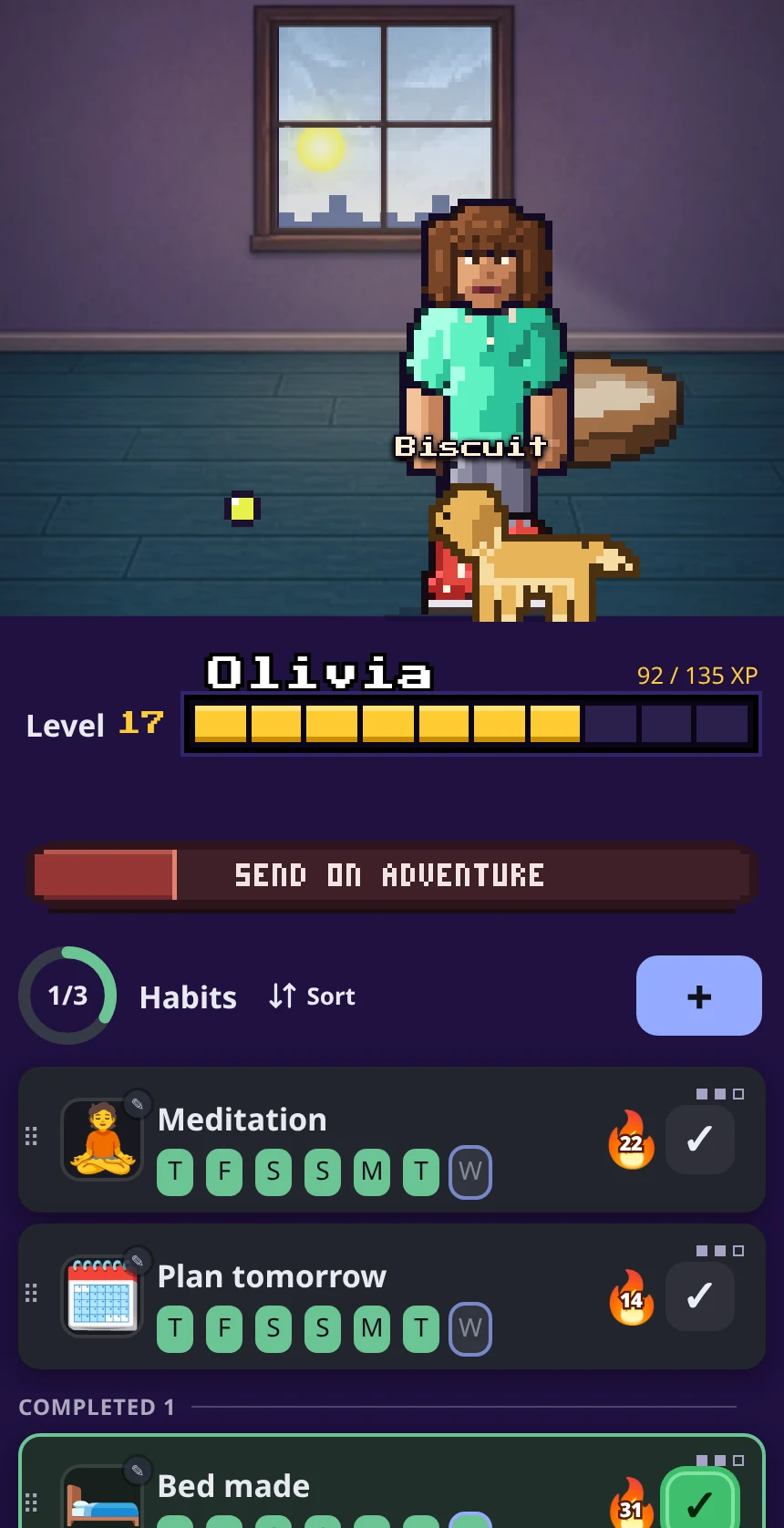
LevelHabit turns your routine into a small RPG. Each habit you check off earns XP for your pixel hero, your streaks grow day by day, and your pet hangs out in your room while you get going. That quick, visible reward may help mornings feel less like a chore and more like a game you want to keep playing.
Key takeaways
- Start with three small steps in a fixed order.
- Link each step to a cue with an if-then plan.
- Keep the routine visible and check steps off as you go.
- Move decisions to the night before.
- Have a smallest-version plan for hard days, and expect habits to take weeks, not days.
This post is for general information and isn't medical advice. If ADHD is making daily life hard, a doctor or mental health professional can help.
Build your hero, pick your pet, and check off each step of your morning.
Sign up free · Ages 13+
Sources
- Gawrilow, C., & Gollwitzer, P. M. (2008). Implementation intentions facilitate response inhibition in children with ADHD. Cognitive Therapy and Research, 32(2), 261–280. https://doi.org/10.1007/s10608-007-9150-1
- Lally, P., van Jaarsveld, C. H. M., Potts, H. W. W., & Wardle, J. (2010). How are habits formed: Modelling habit formation in the real world. European Journal of Social Psychology, 40(6), 998–1009. https://doi.org/10.1002/ejsp.674
- Bijlenga, D., Vollebregt, M. A., Kooij, J. J. S., & Arns, M. (2019). The role of the circadian system in the etiology and pathophysiology of ADHD: time to redefine ADHD? ADHD Attention Deficit and Hyperactivity Disorders, 11(1), 5–19. https://doi.org/10.1007/s12402-018-0271-z
Related: Habit stacking 101 · ADHD and rewards · Building habits with ADHD · ADHD cleaning routine: a room-by-room plan · Time blindness and daily habits