
Gamified Habit Tracker for ADHD: A Practical Guide
If you've downloaded a habit app, used it hard for a week, and then forgot it existed, you're not alone. Plain checklists can feel flat, and for many people with ADHD, "flat" means "forgotten."
A gamified habit tracker tries to fix that by turning daily habits into something closer to a game: you earn points, level up, and see progress right away. This guide covers what the research says, which features are worth looking for, and how to start without burning out.
Quick note: this article is general information, not medical advice. A habit tracker is not a treatment for ADHD. If you're looking for diagnosis or care, talk to a qualified health professional. The NIMH ADHD page is a good place to start.
Why habits can feel harder with ADHD
Rewards that are far away can feel weaker
Many habits pay off slowly. Drinking water, reading, or tidying up won't feel very different after one day. Research on reward processing suggests this delay may matter more for some people with ADHD:
- A brain-imaging study of adults with ADHD found weaker responses in the brain's reward system and different activity when rewards were delayed (Plichta et al., 2009).
- A study of adolescents with ADHD found that they tended to prefer smaller rewards now over larger rewards later, more strongly than their peers did (Cortex, 2018).
Brains differ, and not everyone with ADHD experiences this. But if waiting weeks for a payoff makes you lose interest, adding a small reward right now may make it easier to show up.
Habits take longer than "21 days"
In a well-known study, it took participants an average of 66 days for a new daily behavior to feel automatic, with a range from 18 to 254 days (Lally et al., 2010). That's a long time to stay motivated with nothing but a checkbox.
The same study had good news too: missing one day did not meaningfully hurt habit formation (BPS summary). One off day isn't failure.
Does tracking habits actually help?
Yes, the evidence for tracking itself is solid. A large meta-analysis of 138 studies found that monitoring your progress toward a goal helped people reach it, and the effect was bigger when progress was physically recorded (Harkin et al., 2016).
So the tracker helps. The tricky part is getting yourself to keep opening it. That's where gamification comes in.
What makes a habit tracker "gamified"?
Gamification borrows the parts of games that make you want to come back:
- Points and levels: every check-in earns something you can see.
- Instant feedback: a sound, an animation, or a progress bar that moves now, not in six weeks.
- Visible progress: a character, a room, or a collection that changes as you stay consistent.
- Small goals: daily targets small enough to win on a hard day.
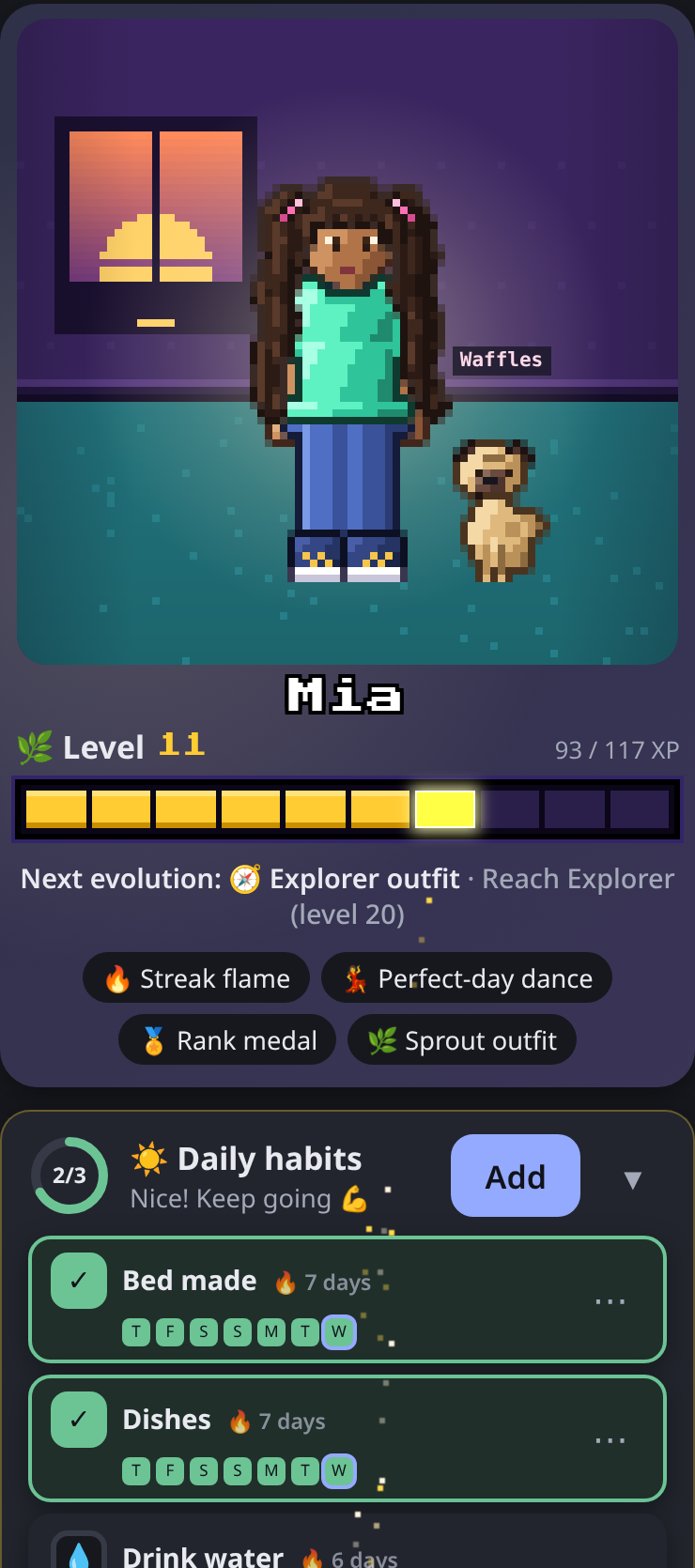 Right after checking off "Bed made" and "Dishes": Mia's XP bar fills toward Level 12 (93 / 117 XP), confetti pops, and the daily ring shows 2 of 3 habits done. Each habit row shows its 7-day streak.
7 features to look for in an ADHD-friendly habit tracker
1. Rewards on every check-in
Look for XP or points the moment you tap "done." Immediate feedback is the whole point.
2. Progress you can see
Levels, badges, or a character that changes. Something you can glance at and feel good about.
3. Low setup friction
If it takes 20 minutes to configure, it won't happen. Start with 2 or 3 habits.
4. Kind streaks
Streaks can motivate, but a reset that feels like punishment can make you quit. Since one missed day doesn't break habit formation, choose an app that treats streaks as a bonus, not a threat.
5. Bonuses for momentum
Rewards for doing habits back to back, or for finishing your whole list, can turn a so-so day into a good one.
6. Something to care about
A pet or a hero gives you a reason to open the app that isn't just "I should."
7. Variety over time
Novelty fades. New badges, looks, and milestones help keep things fresh after the first few weeks.
How LevelHabit approaches it
LevelHabit is a pixel-art habit tracker where your real-life habits power a hero. Here's how it lines up with the list above (see how it works):
- XP and levels: every habit you complete earns XP and levels up your hero.
- Combos and Perfect Day: chain habits for combo bonuses, and complete everything for a Perfect Day.
- Streak flames: your streak flame changes color as it grows. Flames are just for show, so a reset never takes away your progress.
- Badges to collect along the way (see rewards).
- Hero evolution: your hero grows and changes as you stay consistent (meet your hero).
- A room that gets cozier: keep up with habits like making your bed and doing the dishes, and your hero's room goes from messy to tidy to cozy.
- Pets: pick a dog or cat companion to keep you company.
We also wrote about why we built LevelHabit with ADHD brains in mind and the research behind it.
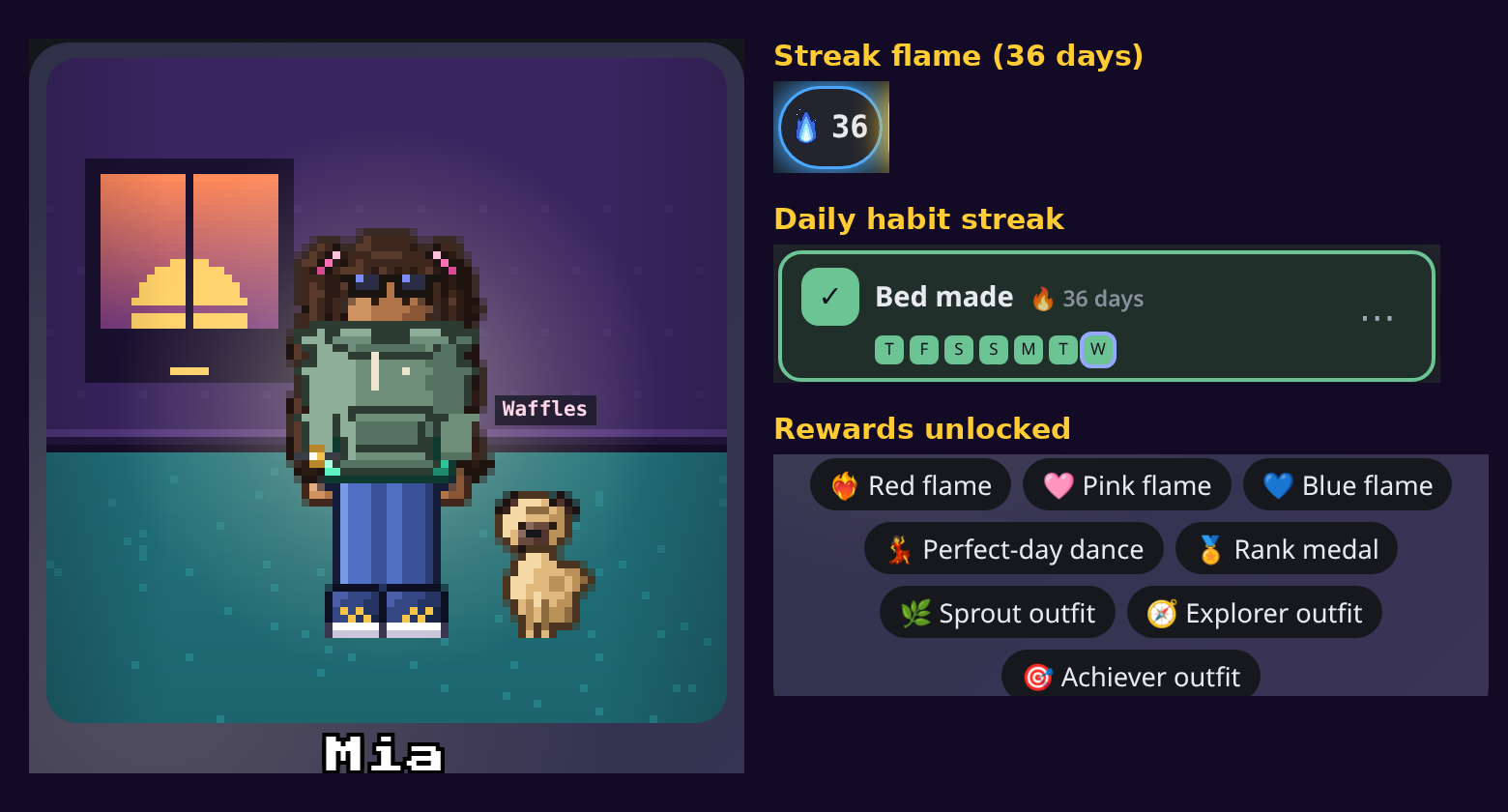 36 days in: Mia and her pug Waffles in her room. Her streak flame has turned blue at 36 days, "Bed made" is on a 36-day streak, and she's unlocked rewards like the Red, Pink and Blue flames, the Perfect-day dance and new outfits.
How to start: a simple 3-habit plan
- Pick one "anchor" habit you already almost do, like making your bed.
- Add one tiny habit that takes under 2 minutes, like drinking a glass of water.
- Add one habit you actually want, like reading 5 pages.
- Tie each one to a cue: "after I brush my teeth," "when I sit down for lunch." Doing a habit in the same context helps it become automatic (Lally et al., 2010).
- Plan for misses. If you skip a day, just do the next one. The research says that's fine.
Give it a few weeks before you add more. Slow and steady beats starting 12 habits on Monday.
FAQ
Is a gamified habit tracker good for ADHD?
It may help. Many people with ADHD find instant rewards and visible progress more motivating than plain lists, and research shows that tracking progress helps people reach goals. It's a tool, not a treatment.
Can a habit tracker treat ADHD?
No. A habit tracker can support daily routines, but it doesn't treat ADHD. For diagnosis and treatment, talk to a healthcare professional.
How long does it take to build a habit?
In one study the average was 66 days, but it ranged from 18 to 254 days depending on the person and the habit.
What if I break my streak?
Missing one day didn't meaningfully affect habit formation in research. In LevelHabit, streak flames are cosmetic, so your XP, levels, and badges stay put.
Who is LevelHabit for?
Anyone 13 and up who wants their habits to feel more like a game.
When can I use LevelHabit?
LevelHabit opens December 1. Sign up free at levelhabit.com.
Curious why LevelHabit exists? Read why I built LevelHabit, the story from our solo developer.
Ready to level up?
Build your hero, pick your pet, and turn your habits into XP.
Sign up free · Opens Dec 1 · Ages 13+
Sources
- Lally, P., van Jaarsveld, C. H. M., Potts, H. W. W., & Wardle, J. (2010). How are habits formed: Modelling habit formation in the real world. European Journal of Social Psychology, 40(6), 998–1009. https://onlinelibrary.wiley.com/doi/10.1002/ejsp.674
- British Psychological Society Research Digest. How to form a habit. https://www.bps.org.uk/research-digest/how-form-habit
- Harkin, B., et al. (2016). Does monitoring goal progress promote goal attainment? A meta-analysis of the experimental evidence. Psychological Bulletin, 142(2), 198–229. https://pubmed.ncbi.nlm.nih.gov/26479070/
- Plichta, M. M., et al. (2009). Neural hyporesponsiveness and hyperresponsiveness during immediate and delayed reward processing in adult ADHD. Biological Psychiatry. https://pubmed.ncbi.nlm.nih.gov/18718573/
- Waiting and working for rewards: ADHD is associated with steeper delay discounting linked to amygdala activation (2018). Cortex. https://pubmed.ncbi.nlm.nih.gov/30005368/
- National Institute of Mental Health. Attention-Deficit/Hyperactivity Disorder (ADHD). https://www.nimh.nih.gov/health/topics/attention-deficit-hyperactivity-disorder-adhd